How I’m Learning to Code

I first learned HTML way back when I was in middle or high school, I can’t remember. Mid-2000s, for sure. I’d even done some CSS – I have vague memories of a website I created where I shared…I don’t remember what, but it was purple – so diving back in hasn’t been too difficult.

Text Editor (it’s not your father’s editor…)

In fact, I’d say it was a breeze. New text editors like Brackets (see below) make coding HTML and CSS much, much simpler, due to color-coded text to make things easy to see and drop down menus to show options for each attribute. Like, why wasn’t this just always a thing?
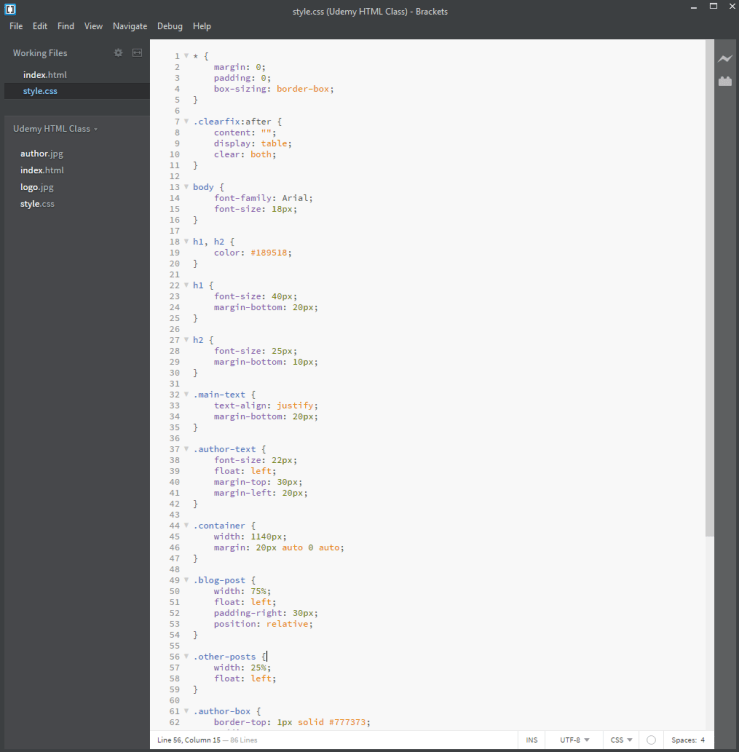
Coding Example

The Course I’m Using

The course I decided to start out with is on Udemy– Build Responsive Real World Websites with HTML5 and CSS3. It’s a mouthful, but it had amazing reviews (as well as being on sale – Udemy has so many sales you can usually get any class you’re after for ten bucks at some point).

The course assumes you have zero experience coding, which was great for me. The instructor even went through how to download Brackets and set it up. The first few lessons went through the basics of HTML and CSS and introduced concepts of web design, from typography to layout to images and colors.

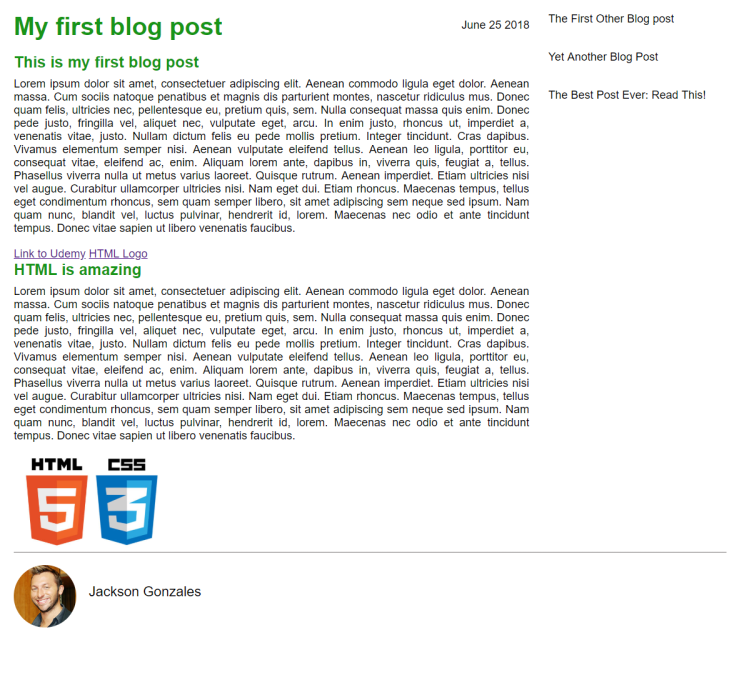
As you learn the code, you get to see it in real time thanks to Brackets’ “Live Preview.” You can see a picture of what you build first in the class below. Not pretty by any means, but it definitely has the look and feel of a standard blog, and you get to do all the coding yourself! It’s pretty awesome.
Coding Practice

The Killer Website Project

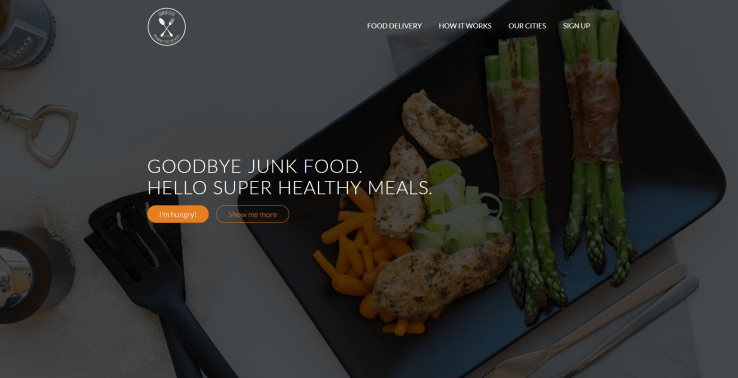
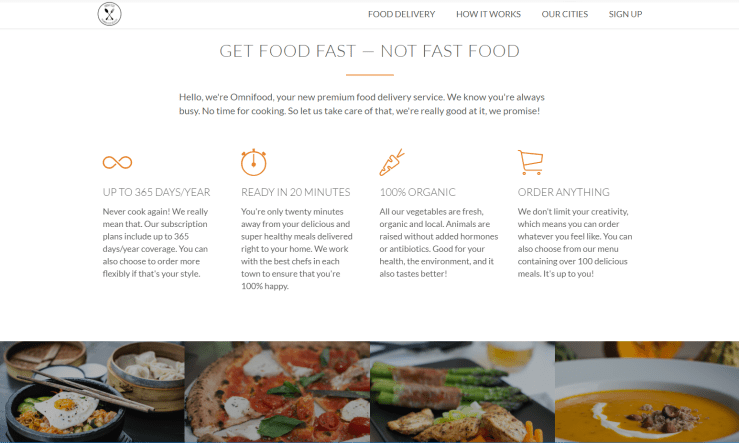
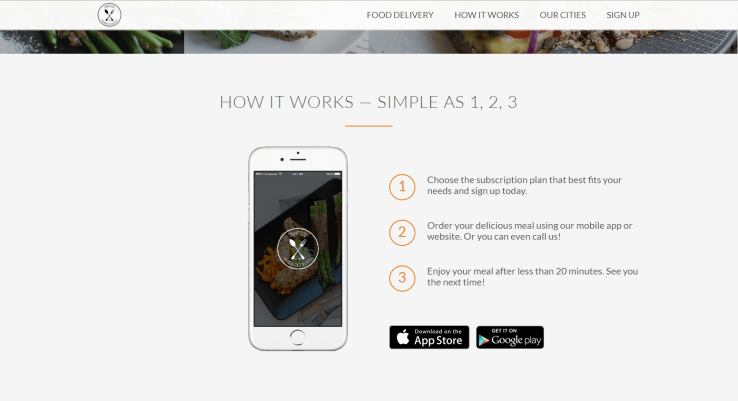
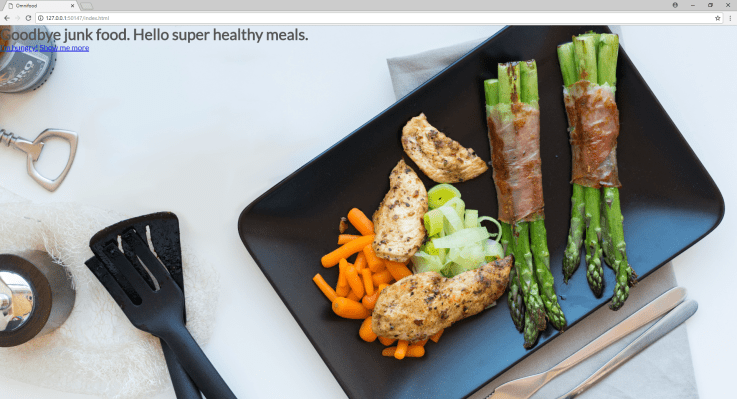
After learning the basics, the main bulk of the course has you build a website for a fake company called Omnifood. You can see the finished project first, and then work through the steps to build it from scratch, which is daunting at first, but it’s surprising how quickly the site takes shape.

I went from this…
Omnifoodtest1

…to this…

Omnifoodtest3

Omnifoodtest2Omnifoodtest4

…in just a few hours. It looks so slick, right?

I don’t by any means feel ready to tackle a paid project yet. I still forget what goes under a <div> element and all the attributes I need to consider, but it was a great starting point, and I feel like this course has really set me up for success in other classes.

Other Resources

Alongside the class, I’m also listening to two podcasts that have been really helpful. They’re more inspiring than practical at this point, but they do point me towards websites and other classes that I know I will use in the future.

Learn to Code with Me

CodeNewbie

I’m also trying to connect with other newbie coders and female coders in my area. Meetup has been the best so far. I recently went to a casual code and connect Meetup of the global group Women Who Code (WWC), and met some amazing people. I made some friends who are learning as well and also got to speak to some recruiters about what skills they’re actually looking for. It was a really positive experience, and I highly recommend anyone starting out to find a group as soon as you can.

Guys, I am just so excited about everything right now. The design aspects, the organization aspect, the editing and the actual coding bits…it’s all amazing! I can’t wait to see where this goes!

Signature

Hello, I’m (becoming) a developer: Self-Discovery Series

I’ve started taking coding classes.

But I’m afraid. Is this just the next in a long line of potential career paths that will fizzle and die along with my invested time and money? Or will I keep the momentum I have for it now? Is it worth investing if I don’t know I’ll keep it up?

Honestly, I’m tired of these questions, because they’re the wrong ones.

In the first place, I’m a multipotentialite, so going after a million different interests is what comes naturally to me. I’d be doing myself a disservice to curtail my passion because of a lack of future certainty. (Which, hello, no one has.)

And in the second place, coding is an incredibly useful skill, so even if I only learn a little, I’m far better off than I was. It’s not like the time I got all into herbal medicine and spent money on a beginner’s class and got a certificate of completion which let me do…nothing. I mean, I had fun, but it wouldn’t be near as useful as basic programming skills in the job market.

But job relevance in only part of my interest. Today I put this picture up on my wall.

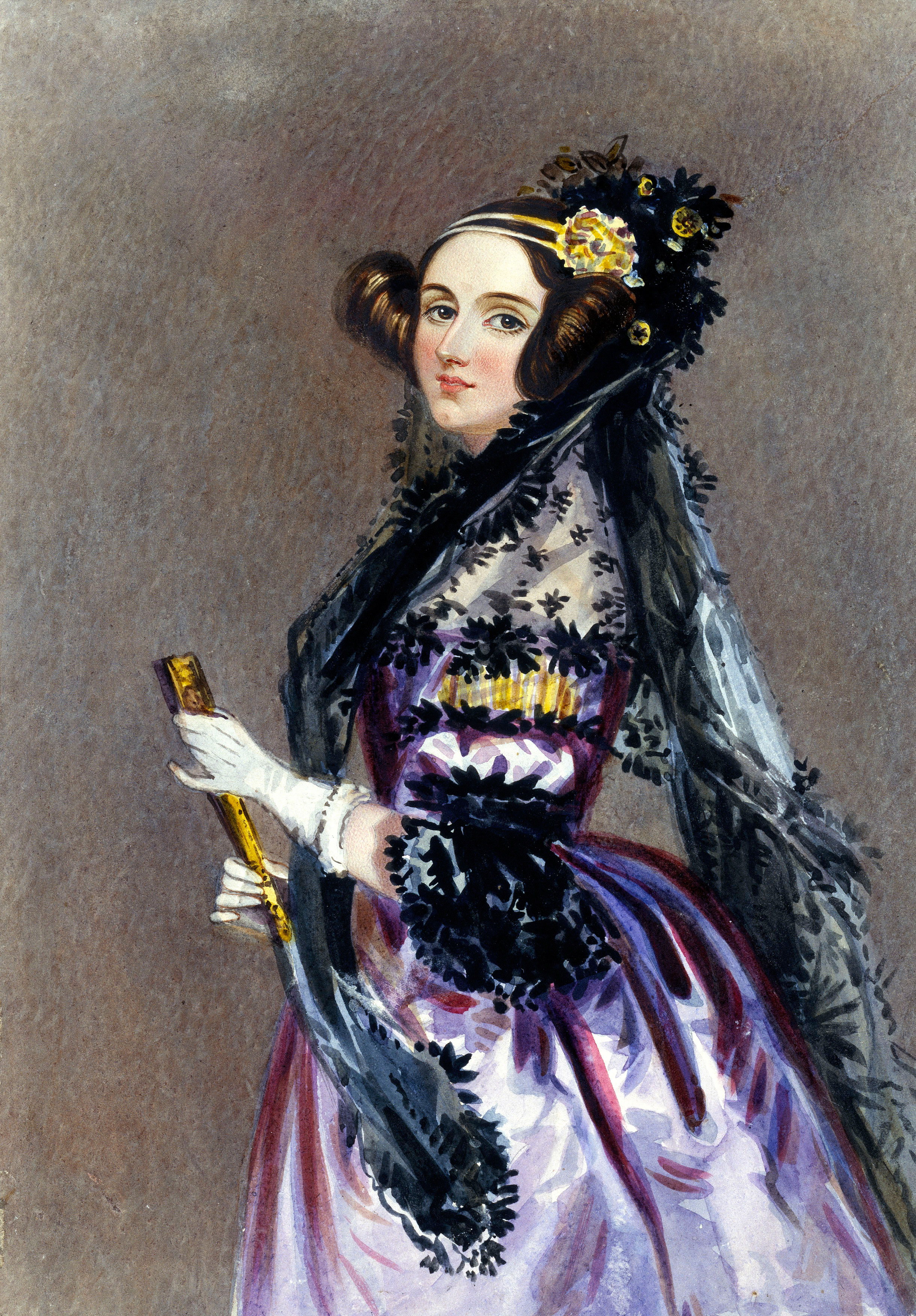
Image result for ada lovelace

This is Ada Lovelace, considered to be the world’s first computer programmer. She’s a WOMAN. And has amazing fashion. I was hecka inspired when I found out about her.

Yes, I’m hoping to get a really good job with these skills. I’d like to be a front-end developer because it seems to be as creative as it is technical. Or a full stack developer, which just makes me think of pancakes.

Either way, whether in the future I am a programmer or whether this fizzles out in a few months, I’m adding programming to my list of hobbies and interests.

In the language of Ruby:

puts ‘Hello World!’

Signature

The Multipotentialite Writer: Multipotentialite Series

When I discovered I was a multipod, I realized that my tendency to pick up interests and drop them ad infinitum was not a deep character flaw but simply a characteristic.

It was liberating to realize there was nothing wrong with me.

But it took me a little longer to realize that my identity as a multipod has meaning for my writing as well.

I write like a multipod. What does that mean? Well, currently, I have several projects I’m working on; fantasy/folklore, horror, memoir, and this blog. I also have a lot of ideas for other kinds of stories in various genres.

There is an internet full of writing advice, and I’ve read many, MANY books on writing in the past few years. Most of it tends to have the same problems for multipotentalite writers as conventional career advice does for multipotentialites in life.

Finish what you start.

– Most advice

As multipods, we’re told to stick with one career, one passion, for life. That’s being debunked as we speak by awesome people like Barbara Sher and Emilie Wapnick (go Puttytribe!), but there’s been so little on multipotentialite writers.

Finish your story, even if you don’t feel like it, or it’s not what you’d envisioned, or it didn’t go the direction you thought. That’s what I read and saw in dozens of places. And it always, always made me feel guilty. Yes, I have finished stories. I think there is incredible value in finishing something, to know you can and to develop the ability to finish a story to its end. I felt hugely accomplished when I finished my first novel two years ago.

But is it always the right thing to do? Is it worth it to keep working on a story you fall out of love with? Writing advice is a bit like dating advice; you’ll stop feeling it, but you must still commit and work at it. That’s what love is. Yes, I agree. That’s what love is. Is that what writing is?

I love metaphors as much as anyone, but in this case, I don’t think love and writing match. Just like I don’t think love and careers match for multipods. The whole “soul-mate,” one-for-life kind of things works for love. I believe in monogamy. I believe in working out a relationship with someone you love, especially when the going gets tough.

I don’t believe in a career soul-mate. Not anymore. It doesn’t exist for a multipod, who will move through careers and passions and interests and must do so. 

It also doesn’t exist for multipod writers. I have at least ten stories going. Conventional wisdom would have me finish each story before moving on to the next one, or, as some less narrow views have expressed, have two projects going that are very different, so if I experience writing fatigue with one I can still keep my writing edge by working on the other. But I’m not allowed to work too much on the other until I’ve finished the one I’ve set my mind on.

It’s bad advice for multipods. It just is. As in life and all our passions, we must be allowed to move between things. We must be allowed to go as far as we need to and let something go when it’s time.

I used to look at all my unfinished stories as black marks against my credibility, but now I see them as stepping stones. There are stories inside me that must come out, and sometimes I have to circle around to them through other stories before I can get to them.

I’m circling around my point as well.

The point is; if you are a multipotentialite and a writer, you will have many projects at once, and you will bounce back and forth between them, leaving some unfinished. And that’s okay. That is natural for you, as natural as bouncing between interests is.

Once I realized what was happening, and that I was feeling the same guilt with my writing as I once did with my interests, I had a real ‘aha’ moment. I decided to allow myself the freedom to write whatever I wanted, as long as I was hitting my mini-habit goal of fifty words a day.

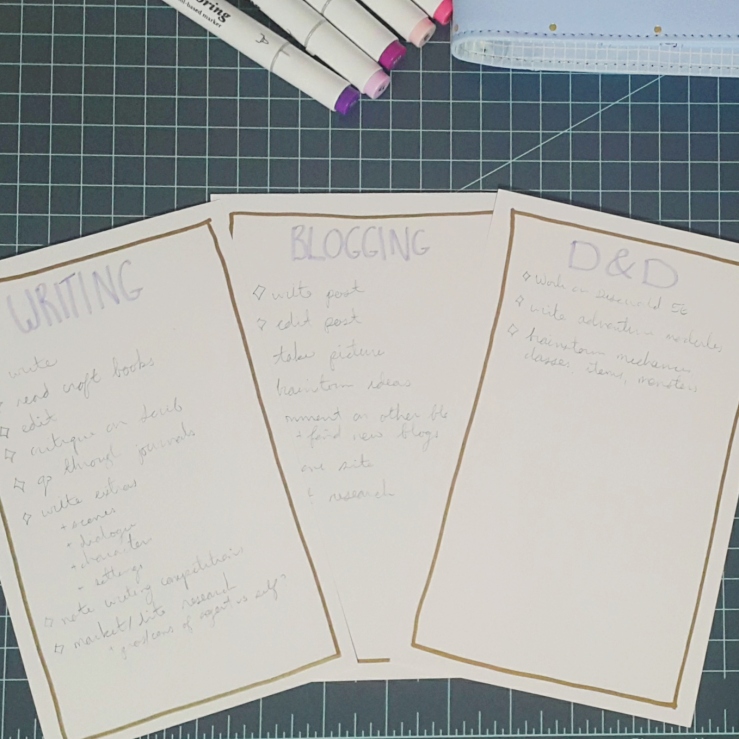
I made cards like the Rotating Priorities Board, one for each writing project, and taped them to my wall – there to switch around as my feeling dictated per day. Now, I can look at all my options and go with the one I’m feeling most in tune with that day or week. And usually, it’s not a case of five minutes here, then five minutes there. I really don’t think that could be productive. But I have found that some weeks I’m really into blogging, so I write a dozen or so posts. That’s great because there are other weeks when I just want to work on my story, and I have those blog posts already ready to go.

And then some weeks I just need to journal, so that’s my writing.

But no matter what, I’m always writing, and I’m fulfilling my need. It’s just not in the same way as other writers; writers who, like the one-career-for-life people we see, can dedicate years and years to a single book. We think we should look like them. We think we should have the same kind of writing attitudes and work desk and schedule that they do, and as multipods, we forget that our multipod identity extends even within our interests.

I’m here to tell you that as a multipotentialite writer, your writing journey will look different, and that’s okay.

Signature

Rotating Priorities Board: Multipotentialite Series

Processed with VSCO with  preset
I made much prettier ones in Korea, but you get the idea.


This is the third and probably last post related to Barbara Sher’s book Refuse to Choose (read my review). Today I’ll be discussing the idea of the Focus Board or the Rotating Priorities Board.

The Idea

The Focus Board is a very useful tool for multipods like me who have a basic set of interests that tend to cycle around. Yes, I have interests that come and go only once, but many of my hobbies are mainstays. The intensity of the interest I have for them will wax and wane, but these few have never dropped off the radar altogether.

Currently, my Focus areas are; Writing, Crafting, D&D, and Blogging. Back when I first started the board, I had Health instead of D&D, but that’s changed over the last few months and so I’ve updated my board. That’s perfectly fine and exactly what this tool is supposed to do.

Why Rotate?

The reasoning is straightforward. You have several categories of things you’re interested in, and you want to make progress in each one, but if you try to schedule or focus on one until completion, you often find you can’t do that. A more specific example might be that you want to write a short story. That has steps and requires several days or weeks of solid work. You’re happy to do it, and it’s something you’re really interested in, but you have other things that occasionally creep up on your interest-o-meter (my word, bam).

The solution? Rotate.

In Practice

Let’s break it down further. I want to write a short story. I’m writing and all is fine and well until the third day when my interest begins to wane. Oh no, there goes that idea, I think to myself sadly, shelving the story as I move on to the paper dragon project that is so awesome I can’t stop thinking about it. Just at that moment, anyway.

But I don’t have to shelve the story. What I should do is put the “Writing” sheet underneath and put the “Crafting” sheet on top, work on the dragon until that interest fades, and then pick up the story again. If it’s been a really long time since I’ve written and I haven’t gotten the bug, there might be another issue than just interest. Maybe it wasn’t the story I needed to tell, or maybe writing isn’t my thing. That’s another issue for another post. This board is for things that DO come back around.

I always come back to writing, even if my interest wanes for a week or two. I always have a crafting project I’m doing at any given moment, be it knitting, paper craft, or bullet journaling (which I consider crafty). Lately, I’ve been creating and planning a lot of D&D related stuff, so I put that in, and blogging I keep separate from writing for my own purposes.

How to Make the Board

You can do this any way you want. In Korea, I made these really nice squares of colored paper that I pinned to my bulletin board at home.

On the top of each square I would write the title, like “Writing,” and under that I would list the things I could do to advance the goal I had for it.

In writing I might have; writing, reading how-to novels, novel research, editing, critiquing or reading others’ critiques. For blogging I have; write blog posts, edit existing drafts, take pictures, comment and network on other sites, and improve my site overall.

In crafting I have; knit, work on paper project, and make journal layouts. For D&D; write an adventure, work on my campaign, work on my characters for the games, watch DM how-tos online, and read the guidebooks.

Each of those things would help me work towards whatever goal I had in mind. You could make more concrete steps in a sequential order, or have only one or two or ten or twenty items you could do. It’s up to you and what your needs are.

You can have these as notes on your computer desktop, as physical paper on your wall or in a planner, or whatever works for you. I love this system because I have one up top prominently displayed that I’m very interested in at that moment, but if I lose interest, I move it out and move another up. There’s no guilt and there’s no pressure because I know it’ll come back around. For multipotentialites, forcing interest past its natural curve is nearly impossible, and often causes us to lose that interest altogether when it’s been tainted by guilt. So don’t do that.

I highly encourage you to try it. Even if making stuff isn’t your shizz, just making sticky notes on your computer that you’ll see when you start your day can be enough. It doesn’t have to be fancy. It just has to work for you.

If you give it a shot, let me know! What are your Focus areas?

Signature


Life Accomplishments: Multipotentialite Series

This is another post inspired by Barbara Sher’s book Refuse to Choose. I’ll be doing a few of these, as it’s one of my favorite books for multipotentialites, and it has so much practical advice.

In the book, she asks readers to make a list of everything they’ve done in their lives (read my review).

The reason is that many multipotentialites, by nature unable to settle down to one thing, often reach a point in their lives when they feel as though they haven’t really accomplished anything. While friends have gone smoothly up the corporate ladder, or smoothly down the homemaking trail, or smoothly into whatever field they’ve loved forever, for mutlipotentialites, our patchwork lives can seem…lacking.

I made my list, and it was a great exercise in reality. I’ve often felt that my life has been very piecemeal; this bit here, that bit there, this interest over here, but nothing connected, nothing coherent.

My timeline of accomplishments will never be coherent (hallelujah), but it does help me realize that I have actually done a lot in my life.

  • Painted my own storybook and table set (to match, aww)
  • Made jewelry
  • Made baby clothes
  • Made dolls (knit, waldorf, felt) and doll clothes
  • Knit a blanket for my neighbor
  • Knit a sweater for my mom
  • Won prizes for equestrian showmanship and Western riding
  • Learned to ride Western and English
  • Learned to jump
  • Learned etiquette at Cotillion
  • Learned to dance (waltz, foxtrot, jitterbug, swing, Charleston, English Country)
  • Knit mug cozies, scarves, gloves, socks, hats
  • Embroidered bags
  • Cross-stitched
  • Placed in an art show in high school
  • Taught in Taiwan
  • Volunteered at a therapeutic horse riding center and won an award
  • Wrote a novel
  • Played D&D (a performance feat if ever there was one)
  • DMed Dungeons and Dragons
  • Began woodworking
  • Made natural beauty products
  • Made herbal medicine
  • Learned Chinese and Korean
  • Learned basic Swedish
  • Drew comics
  • Traveled to Russia, New Zealand, and around the US
  • Taught in Korea
  • Designed a car with my friend in middle school
  • Made a pinhole camera
  • Developed pictures myself (from negatives in a chem bath)
  • Learned HTML/CSS
  • Graduated college Summa Cum Laude
  • Got a promotion
  • Learned to tat
  • Got the highest score on my AP art portfolio
  • Made several fantasy/sci-fi/medieval costumes
  • Sewed clothing
  • Made a quilt
  • Painted portraits
  • Owned horses
  • Made scrapbooks/art/bullet journals
  • Cut paper art

This list is like a love letter to myself, gently reminding me that yes, I have done things with my life. Yes, I have used my time well. I’m young, objectively speaking, but it’s hard for anyone over 12 to feel objective when 12- and 13-year-olds (or even younger, who am I kidding?), routinely do incredibly amazing things in art and science and performance. It’s hard, but it’s necessary. Just because I didn’t publish my first book at 10 doesn’t mean I’m not a good writer. There’s no correct or best timeline for anyone.

If you’ve ever struggled with feeling like you’ve never done anything, make your own list. Include books you’ve read or games you’ve played or places you’ve lived or people you’ve met. Those are all accomplishments. And big or small, they are important.

Signature