Changing My Life: Discovery Series

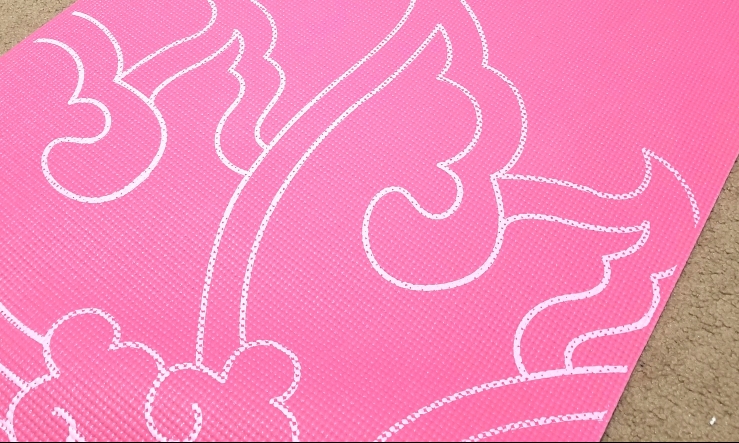
20180323_122359.jpg

I realized something the other day that got me really excited. I am someone who exercises.

Let’s back up. My whole life I have been someone who never exercised. I’ve never enjoyed it and all my attempts invariably failed. Like many kids, I did soccer and basketball and equestrian sports through high school, but there’s a difference between that and exercise.

After high school, when I couldn’t afford jumping lessons anymore, I stopped altogether. Sure, I tried P90X and various other “fun” and “x-treme!” cardio videos, and even aimed for the Color Run one year, pounding away around my apartment complex, but I never, ever enjoyed it. I figured that exercise was just a necessary evil that I would probably never really do with enough consistency to make it matter. I even got into boxing while in Korea, but though I loved doing it, only stuck with it a month.

To sum up; the storyline and identity I had in my head about myself was that I was not a person who exercised. That was true until this year.

This year, I moved home from Korea. This year, I decided to exercise every day. This year, I have exercised every day. And I had to stop and realize that the old identity (someone who doesn’t exercise) isn’t true anymore. I’m now someone who exercises every day.

How did I do it?

I made a plan while I was still living in Korea. I had just been hit with a devastating health crisis and knew I would be moving home to deal with it.

My plan was to start with gentle yoga, which I could just about handle. Find a good series and do the beginner videos, and if I had to stop halfway through, that was okay.

Next would come more intense yoga as I built up strength and flexibility from zero.

Then I planned on getting into pilates and more cardio type stuff, moving from there to boxing again (since I enjoyed it so much) and maybe even to MMA (I’ve always wanted to learn).

Right now, I’m smack dab in the middle of the intense yoga and pilates phase. I’ve been doing yoga every day and this week I started a pilates program. (Let me just say, I did a booty bootcamp video and haven’t been able to walk straight for two days. Um, success?)

It’s an audacious plan, and obviously I don’t know how far I’ll go, but so far? I’m doing really well.

I decided to exercise every day before breakfast. I have no idea if that’s the best option or what, but for me, it definitely is. If I know I have to wait to eat until after I’ve worked out, I will get to my room and roll out that mat first thing. Plus, tying it to waking up is a strong habit signal.

I wake up, drink some water, head to my office and the very first thing I do is roll out the mat. I usually meditate first as well, but the first action I take in the morning in that room is to roll out the mat. I made sure that no matter what else happened, that mat was out. Some days I was already starving before I began, other days not. Some days it felt like the worst thing to do yoga, and other days (more and more these days) it felt amazing.

And it worked! I went from someone who never exercised to someone who exercises every day. It’s become habitual!

The Results

I did gentle yoga for all of January, alternating between several of Adriene’s videos on Youtube.

In February I noticed I could do downward dog for once, was getting less shaky overall, and was actually enjoying the practice each time. I was enjoying pushing myself (that had never happened).

So by mid-February, I knew I was ready to move up, and started Adriene’s 30 days of yoga series she did a couple of years ago. I figured it would be a good way to progress naturally. I alternated it with other, gentler videos for days that were rough (as someone with anxiety, I need that option to be kind to myself), but mostly I kept up with it.

Now in March I’ve been finishing up her course and, as I said above, starting in on Pilates.

I’m using the Blogilates videos by Cassey Ho. I’ve followed her on Instagram for a while and I love her personality, so it was an easy transition. Well, I say that….damn my thighs and butt hurt.

I’m doing the 6 Week Body Toning Bootcamp, which is one video per week, but I guess you repeat each video to get a full workout. I did the first one, the booty one, two days ago but could only get through two runs. I mean, I barely made it through the first run. And between the pilates videos I’ll keep up yoga to help stretch the sore muscles.

I’m really happy. I did it, I’m sore, but I’m not discouraged. My whole attitude has changed along with my identity. It was amazing when I stopped to realize that my whole identity had to be altered.

If you’ve ever struggled to keep up an exercise program, don’t get discouraged! I thought I would never be a person who could do it once a week, let alone every day, and here I am. I tried and tried for years until I found something that worked, and you can too!

Best of luck!
Signature


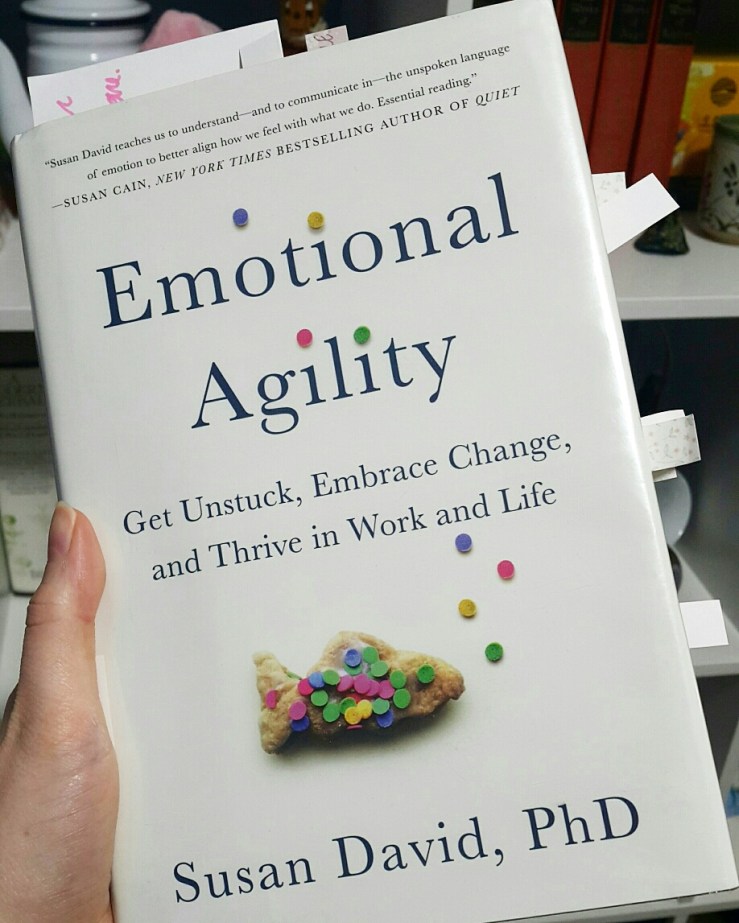
Emotional Agility by Susan David: Book Review

IMG_20180223_161559_068

Emotional Agility is a book everyone should read. It’s a book that takes the ideas about mindset and how to live a good life and gently turns them on their heads. You know, mugging me gently of all my faulty ideas.

I did a short summary of the TED Talk by Susan David, the author, but that was just about the Talk. I hadn’t read the book yet. Right after watching the video and writing about it I put the book on hold at the library and waited. It was worth the wait, but I wish I had read this book years ago. Again, required reading from birth.

Overview

If I were to boil the book down to one essential life lesson, it would be this:

Between stimulus and response there is a space. In that space is our power to choose our response. In our response lies our growth and our freedom. – Viktor Frankl

It is in that space that emotional agility lies – in the ability to open up about your feelings; all your feelings.

David gives a lot of ways to do this; that’s what the book is about. She takes us through building emotional agility as opposed to rigidity and uses examples from her own life and her career in psychology.

A lot of this hit home with me. Which is obvious when you see how many markers I put in the book. If I’d owned it, it would have been highlighted until it was more yellow than white.

All Emotions Are Useful

Notice I said “useful,” not “pleasant.” Of course, anger and pain and grief and boredom are not pleasant emotions, but that doesn’t mean they aren’t useful.

David says that emotions are indicators; data. They tell us information about ourselves and our surroundings. You notice you are feeling sad, now ask yourself why. What made you sad, and why did it make you sad?

Rigidity in emotions comes when we use the same old techniques we’ve used all our lives, often from childhood, that served well enough to protect us, but have long since ceased to be useful or even true. David says this is true especially if you’ve been neglected or abused in marriage or in childhood. Thinking people can’t be trusted or you’re going to be hurt was true and possibly helpful in your situation, saving you from immediate pain and danger. But once out of that situation, that thinking, that everyone is going to hurt you, is no longer always true, and no longer serves you best.

I have experienced this. I had a rough first relationship, and ever since, I’ve assumed I’ll be hurt again if I open myself up to intimacy. It’s not true, and it’s not helpful. Sure, I could get hurt, but living while accepting that as my only fate has brought me no joy and lots of anxiety.

David warns though that emotional agility does not mean controlling your thoughts or forcing more positive emotions. “…research also shows that trying to get people to change their thoughts from [negative to positive] usually doesn’t work, and can actually be counterproductive” (David).

That’s where the space between the thought and action comes in.

The Storylines in Your Head

It’s amazing how often I’m hearing about this. I heard it first in my meditation practice, and now again, David talks about the narrative we make of our lives.

We take the vast amounts of information from our environments and coalesce them into something cohesive; This is me, Audra, waking up. (I’m paraphrasing her own narrative.) I am in a bed. I live in Texas. I have to get up today and do yoga because I chose to be healthier. Later I will write a blog post because that’s what I do. I’m a writer. 

David says, “The narratives serve a purpose: We tell ourselves these stories to organize our experiences and keep ourselves sane.” The problem, she goes on to say, is that we get it wrong. We don’t have the whole truth of any situation. We can’t; there’s just too much going on and interconnecting every moment of every day. Stories help us navigate. Those who really go wrong we label psychotic or delusional (or anxious? hello), but in reality, none of us gets it exactly right. We invent our town truth about who we are, in other words.

David called the process of getting invested in our storylines being “hooked.” Getting hooked means getting caught by an emotion or behavior, whether good or bad. We get hooked and play out the storylines that have served us (well or not) in the past. That coworker snubbed me, she must hate me. I’ve never been popular, I must be so unlikeable. No, she’s unlikeable. What a bitch. 

When, in fact, that coworker might not be thinking of you at all, and honest communication could get to the real issue. The point is, being hooked is dangerous.

Fear Walking

One of the greatest things about this book for me, as someone who struggles with anxiety, was David’s idea of courage being fear walking. Courage doesn’t mean the absence of fear. We hear that a lot, in movies and books, but not enough.

We have to lean into our bad emotions, not pull away from them. We need to feel the fear, or the sadness, or the grief, and accept it. Telling a child not to cry when they get their first shot isn’t helpful. Of course they can cry, it’s scary and painful and that’s okay. It’s not okay for them at the moment, and we shouldn’t pretend it is. It will be okay, and they will discover that.

Let your inner child cry when things aren’t okay. That’s okay.

Social Comparison and Self-Acceptance

We all know the comparison game. It’s rife now, maybe more than ever, but even if Instagram and Twitter have made it blow up, it doesn’t really matter. Everyone since forever has been trying to keep up with the Joneses.

David’s advice? Keep your eyes on your own work. That old adage from school (one that I, as an elementary teacher, said a lot) is worth keeping in mind as we grow up. Don’t look at other’s work. Don’t compare it. They are not you. And especially don’t compare with someone way out of your league. A beginning violinist should not compare themselves to Joshua Bell. A beginning track runner should not compare themselves to Usain Bolt.

It’s okay to look just above you, for that goal that is truly a challenge (just above your skill level – or the sweetspot). That can foster healthy drive. But if you have trouble with comparison and perfectionism, keep your eyes on your own work. (I actually wrote this out and stuck it to my wall.)

What the Func?

I touched on this briefly in my review of the TED Talk, but basically, this means asking what the func (function) is of your emotions and thoughts. Emotions are data to be used, not be controlled by.

And it’s important to be specific. What are you stressed about? What is making you feel guilty? What is the reason for the apathy you’re feeling?

One of the best ways to discover and distance yourself from an emotion is to say or think, “I’m noticing that I’m feeling/thinking…” This keeps us as bystanders and observers of ourselves. It’s not helpful to say, “I’m stressed,” because that invokes the idea that you are an emotion, which is not true. You are not stressed. You are feeling stressed. So ask yourself, why? What’s the func?

Another good way to get some distance and some clarity is to identify your values; for it’s often when our values are being stepped on that we feel those negative emotions in the first place. What value might you be sidestepping to make you feel stressed or sad?

Dead People’s Goals

The last idea I want to mention is the idea of trying to live a life free of worry, stress, grief, and pain. David calls that having dead people’s goals, because only dead people are free from those feelings.

To live and to be human is to be sad and happy, to be hurt and feel love, and experience grief and joy. (To everything there is a season.) We must not turn away from the emotions we don’t want, but lean into them and through them and come out stronger.

Don’t have dead people’s goals. Get up, find your courage, and walk in fear. But make sure you walk.

Signature

The Downside of Minimalist Living


pexels-photo-775219.jpeg
Yes, the mountains. YES. But uh, where do I keep my chapstick?


My Story

I’m a big fan of minimal living. I am. I love the idea of living out of one suitcase, even though I’ve never managed that (although I did manage about 2 and a half at one point).

I’m also a huge fan of the KonMari method of organization. KonMari focuses on keeping only what sparks joy, which means discarding anything that doesn’t, and in America, that means about 90% of your stuff. It did for me. I had clothes I didn’t really like, books I had never read and never would read, knick-knacks that had no value and papers from everywhere I would realistically never need again!

I love throwing stuff away, as I’m easily bogged down mentally and emotionally by clutter. Organizing makes me feel fresh and rejuvenated, and the less stuff I have, the better.

Or so I thought. In reality, a few years after I started living pretty minimally, my opinion has changed from “keep as little as possible” to “maybe I should have kept some more things.” (I tossed a lot of childhood stuff in a fit of unsentimental get-rid-ed-ness, and I’m beginning to wonder if maybe that wasn’t so…)

Because keeping only what brings joy isn’t as simple as it sounds. When you’re on an organization bender, and you’re a specific type of person (i.e – me), you might find that what brings you joy in the midst of cleaning is the throwing away of stuff. It was like that for me. I was ruthless. I was as unsentimental about old stuff as it was possible to be.

I had a bit of a special situation when leaving Korea – I was trying not to ship anything or bring a third suitcase home (both very expensive) and that meant really, really keeping only what I needed and wanted. I left behind books and a lot of shoes and a lot of stationery stuff, thinking at least I could replace that easily enough.

(Bit of advice; if you love stationery and you live in Asia where you can get all that awesome stuff cheap, keep it. I’d somehow forgotten that you can’t find stores like that in America, and the stuff you do find isn’t cheap.)

The Downside

We rarely hear about the downside of minimalism, because the idea is good. You don’t need all that stuff. You don’t need that storage unit. Well, we didn’t; we just thought so.

So when is it a bad idea? When you get rid of too much. When the pendulum swings from terrible over consumption and over buying to not buying enough. There are benefits to having certain things, and sometimes those things can feel like a lot of things, but aren’t really a lot. Of things. Um.

Example; I just bought a few books. I was hesitant to buy them because a) money, and b) they were solid, real, tangible books that would forever be in my care unless I donated them later. Stuff has psychological weight.

I almost didn’t buy them. But I wanted them. Specifically, these are books related to D&D, something I’m really passionate about. I will use these books a long time, possibly for decades. D&D is one of my major hobbies, and it’s OKAY to spend money on your hobbies. That’s what I had to keep telling myself. It’s okay to buy things you will love and use forever. It’s okay to buy real books again.

I had to buy furniture to furnish my office when I moved back to Texas, and that was also really hard because fuuuurrrniiitttuuureeee is also expensive and so REAL. Like yeah, you’re rooting down.

And I bought my first ever desktop computer. Before, I’d always used a laptop because I was always on the go; to college, to Taiwan, back to college, to Korea. A desktop would have lain dormant.

Now I have a desktop. And two new amazing desks and an awesome shelf system for all my cool, favorite stuff.

It rocks. It’s not minimalist. It’s not. I don’t have 10 books spread between the 16 shelf cubes with only a decoration or two. No, I have a lot of books and a lot of souvenirs. And it’s perfect.

It’s given me a sense of belonging. When you live in transience, in the mindset of living with less, it’s easy to merge that with the idea of impermanence. Living with less so you’re easier to move around.

That’s fine for some people. It was great for me for a long time.

It’s not great forever, for some people. I loved buying a desktop. It was like buying a car. I’m an adult, I thought, finally. I loved investing in those D&D books. I want to DM, and those will be valuable resources.

As Matt Colville says, one of my all-time favorite Dungeon Masters, he buys a lot of expensive stuff for his D&D sessions. Like, hundreds of dollars worth of minis and sets and books and stuff. But he says that’s okay. He’s been collecting this stuff for over thirty years. He’ll keep using it. It’s his passion and his hobby, and that’s what living is for. To pursue your passions.

Don’t let minimalism and the fear of settling down starve you of the stuff you really do want.

That’s minimalism gone bad.

Signature

Life Accomplishments: Multipotentialite Series

This is another post inspired by Barbara Sher’s book Refuse to Choose. I’ll be doing a few of these, as it’s one of my favorite books for multipotentialites, and it has so much practical advice.

In the book, she asks readers to make a list of everything they’ve done in their lives (read my review).

The reason is that many multipotentialites, by nature unable to settle down to one thing, often reach a point in their lives when they feel as though they haven’t really accomplished anything. While friends have gone smoothly up the corporate ladder, or smoothly down the homemaking trail, or smoothly into whatever field they’ve loved forever, for mutlipotentialites, our patchwork lives can seem…lacking.

I made my list, and it was a great exercise in reality. I’ve often felt that my life has been very piecemeal; this bit here, that bit there, this interest over here, but nothing connected, nothing coherent.

My timeline of accomplishments will never be coherent (hallelujah), but it does help me realize that I have actually done a lot in my life.

  • Painted my own storybook and table set (to match, aww)
  • Made jewelry
  • Made baby clothes
  • Made dolls (knit, waldorf, felt) and doll clothes
  • Knit a blanket for my neighbor
  • Knit a sweater for my mom
  • Won prizes for equestrian showmanship and Western riding
  • Learned to ride Western and English
  • Learned to jump
  • Learned etiquette at Cotillion
  • Learned to dance (waltz, foxtrot, jitterbug, swing, Charleston, English Country)
  • Knit mug cozies, scarves, gloves, socks, hats
  • Embroidered bags
  • Cross-stitched
  • Placed in an art show in high school
  • Taught in Taiwan
  • Volunteered at a therapeutic horse riding center and won an award
  • Wrote a novel
  • Played D&D (a performance feat if ever there was one)
  • DMed Dungeons and Dragons
  • Began woodworking
  • Made natural beauty products
  • Made herbal medicine
  • Learned Chinese and Korean
  • Learned basic Swedish
  • Drew comics
  • Traveled to Russia, New Zealand, and around the US
  • Taught in Korea
  • Designed a car with my friend in middle school
  • Made a pinhole camera
  • Developed pictures myself (from negatives in a chem bath)
  • Learned HTML/CSS
  • Graduated college Summa Cum Laude
  • Got a promotion
  • Learned to tat
  • Got the highest score on my AP art portfolio
  • Made several fantasy/sci-fi/medieval costumes
  • Sewed clothing
  • Made a quilt
  • Painted portraits
  • Owned horses
  • Made scrapbooks/art/bullet journals
  • Cut paper art

This list is like a love letter to myself, gently reminding me that yes, I have done things with my life. Yes, I have used my time well. I’m young, objectively speaking, but it’s hard for anyone over 12 to feel objective when 12- and 13-year-olds (or even younger, who am I kidding?), routinely do incredibly amazing things in art and science and performance. It’s hard, but it’s necessary. Just because I didn’t publish my first book at 10 doesn’t mean I’m not a good writer. There’s no correct or best timeline for anyone.

If you’ve ever struggled with feeling like you’ve never done anything, make your own list. Include books you’ve read or games you’ve played or places you’ve lived or people you’ve met. Those are all accomplishments. And big or small, they are important.

Signature


Mini-Habits by Stephen Guise: Book Review

It’s pretty much only coincidence that two of my three book reviews so far are by the same author. Only pretty much, because books that really stick with me (enough to get a review) are rare, and Stephen Guise has written two that have really stuck with me. They are both short. That helps. They are both immensely practical. That helps too. They both took my world and turned it very gently on its head, rummaged in its pockets, and took out all the useless bits to show me why I was wrong. That helps the most.

My first book review for Guise was for the second and most recent work of his I’d read, How to Be an Imperfectionist. Being the second book, it builds upon the previous book, Mini-Habits, about which I will now shut up introducing and get on with reviewing.

The Idea

The idea is very, very simple. Easy enough for anyone, literally, anyone, to understand. A mini-habit is a habit of doing something every day that is very small. For instance, 1 pushup a day. Read 2 pages of a book a day. Things like that.

Guise introduces the idea and then goes on to say why it works. He talks about motivation vs willpower, how waiting until you feel like doing something is the TOTAL WRONG WAY TO DO ANYTHING, and how by using such a small goal, you will hit your target every day, and most of the time, you will overachieve it. You’re on the floor having done 1 pushup, might as well do more, right? And then you’ve done 10. The key though is not to have secret goals, like, I will do 1 pushup a day, but it must actually turn into 50, and then you have the same block against doing the 1 since it isn’t actually 1, it’s 50.

It’s fascinating to read about motivation as well. He cites several studies over the years on the way motivation works in the brain, and let me tell you, it’s not all it’s cracked up to be. Motivation fails too often to make it a good instigator of anything. Cue willpower.

Like I talked about in my review of his next book, the key is to create a positive cycle or streak of successes. Can everyone read 2 pages a day? If you’re reading this blog post, then yes, you can. It’s a stupidly simple goal. So you do that. And rather than focusing on how you want to turn that into reading 2 books a day, you focus on how you’re creating a habit of reading anything at all, every day. Every day is the key. You do something every day and it becomes a habit. You don’t have to think about it. And then you can start hitting bigger goals much more easily since you’ve got that foot in the door.

(Also, apparently, 21 days to implement something as a habit is a myth. It can range from 14 to over a hundred days, if I recall correctly, depending on the habit and the person.)

My Thoughts

When I first read the book a couple of years ago, and first had my world gently mugged, I did my mini-habits very carefully. I don’t remember what they were. I think they were fitness related, so I think I did his one push up a day for a while. But I was just beginning to work overseas, and I secretly wanted more, and what with all that and not being very aware of ownership of my own head at that point, I stopped mini-habits for quite some time.

Until this year, actually. When I came home to get better, had several breakdowns and epiphanies to boot, I found and read How to Be an Imperfectionist (HTBAI), which reminded me of Mini-Habits.

I immediately picked it up again, especially after reading in HTBAI how anxiety is often a result of perfectionism, and how mini-habits punches that in the face daily. Small victories which create a perpetual positive cycle, in a too-brief summation.

My mini-habits are currently; write 50 words, read 1 chapter in the Bible, read 2 pages of a book, exercise for 5 min, and meditate for 10 min. Technically, the meditation should be much shorter, but I’ve had a streak on for over a hundred days and it IS a habit now. I guess I should take it off the list and add it to the list that includes brushing my teeth every day. It’s now just something I do. That’s the goal with all of these.

In Practice

Let’s say you want to write more, which is my major goal for this year. During NaNo, the daily goal must be at least 1667 words or you won’t hit 50k by the end. I’ve done it three years in a row, so I know I can do it. Therefore I thought I must do it every day. I gave myself a little more leeway and went for 1000/day, but after the intensity of November, and the inevitable weeklong writing break I gave myself (which turned into two weeks, then three…) I realized it wasn’t working. 1000 was just too much.

I decided to use his goal of 50 words/day. Because I’m just starting out, I’m counting journaling, blogging, and fiction writing.

So far, I have done it with no problem for about a month, since I arbitrarily decided to start on January 1st (not super arbitrary, and that did happen to be the starting day for the cool habit tracker I printed out, so…).

My first real snag came yesterday. I spent all day out of my house. Sure, I had my small notebook, but I was also feeling crappy and didn’t bother writing in it. I got home around eleven, way past my comfortable bedtime (hello, youngsters), and was so knackered I nearly, nearly gave it up. But I didn’t want to have that blank space in my tracker (I need external accountability to get me to do things, and streaks of check marks help a lot*), so I pulled out my iPad and journaled. I could have spent just about two minutes doing it and written 50 words, but I stayed there for 10 minutes recapping my day, and hey presto, I did my habit. I x-ed off my day. I kept up the streak, and my habit tracker is fat and full and happy.

That’s why it works. No matter what kind of hellish day you’ve had, at the end of it, you can grab your iPad or phone and write 50 words. You can flip over on your bed and do a pushup, you can pull that book over and read 2 pages. That’s the key and the beauty of a mini-habit.

I encourage anyone who’s ever struggled with resolutions or goal-setting or good habit forming to read it and try it out.

Let me know how it goes!

Signature


*See Gretchen Rubin‘s book The Four Tendencies to learn what kind of habit maker you are. It’s a great tie-in to making mini-habits and a fun read too.