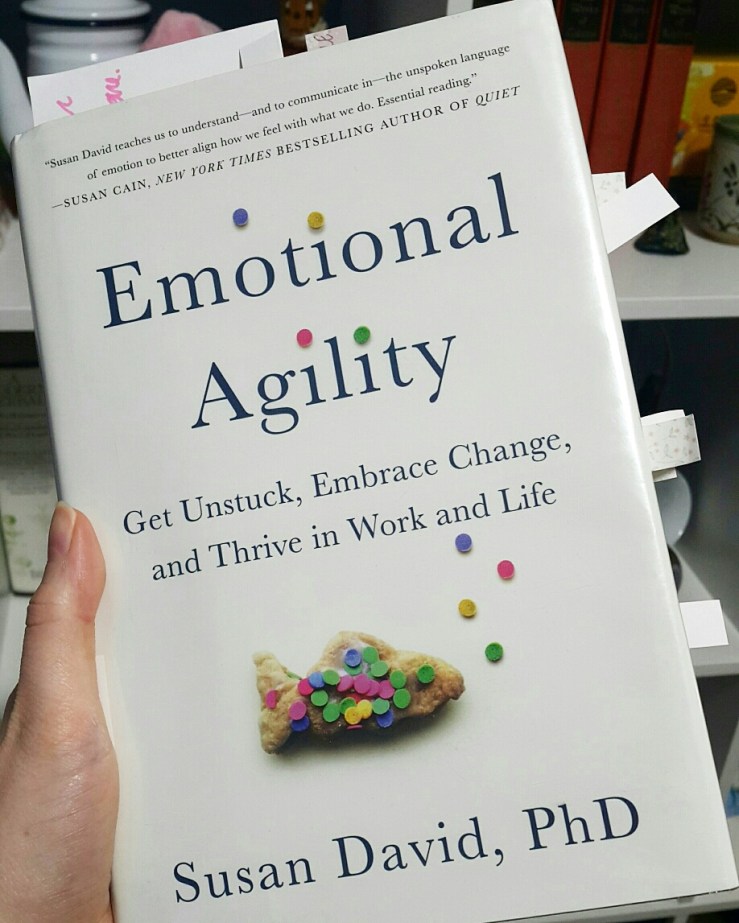
I did a short summary of the TED Talk by Susan David, the author, but that was just about the Talk. I hadn’t read the book yet. Right after watching the video and writing about it I put the book on hold at the library and waited. It was worth the wait, but I wish I had read this book years ago. Again, required reading from birth.
Overview
If I were to boil the book down to one essential life lesson, it would be this:
Between stimulus and response there is a space. In that space is our power to choose our response. In our response lies our growth and our freedom. – Viktor Frankl
It is in that space that emotional agility lies – in the ability to open up about your feelings; all your feelings.
David gives a lot of ways to do this; that’s what the book is about. She takes us through building emotional agility as opposed to rigidity and uses examples from her own life and her career in psychology.
A lot of this hit home with me. Which is obvious when you see how many markers I put in the book. If I’d owned it, it would have been highlighted until it was more yellow than white.
All Emotions Are Useful
Notice I said “useful,” not “pleasant.” Of course, anger and pain and grief and boredom are not pleasant emotions, but that doesn’t mean they aren’t useful.
David says that emotions are indicators; data. They tell us information about ourselves and our surroundings. You notice you are feeling sad, now ask yourself why. What made you sad, and why did it make you sad?
Rigidity in emotions comes when we use the same old techniques we’ve used all our lives, often from childhood, that served well enough to protect us, but have long since ceased to be useful or even true. David says this is true especially if you’ve been neglected or abused in marriage or in childhood. Thinking people can’t be trusted or you’re going to be hurt was true and possibly helpful in your situation, saving you from immediate pain and danger. But once out of that situation, that thinking, that everyone is going to hurt you, is no longer always true, and no longer serves you best.
I have experienced this. I had a rough first relationship, and ever since, I’ve assumed I’ll be hurt again if I open myself up to intimacy. It’s not true, and it’s not helpful. Sure, I could get hurt, but living while accepting that as my only fate has brought me no joy and lots of anxiety.
David warns though that emotional agility does not mean controlling your thoughts or forcing more positive emotions. “…research also shows that trying to get people to change their thoughts from [negative to positive] usually doesn’t work, and can actually be counterproductive” (David).
That’s where the space between the thought and action comes in.
The Storylines in Your Head
It’s amazing how often I’m hearing about this. I heard it first in my meditation practice, and now again, David talks about the narrative we make of our lives.
We take the vast amounts of information from our environments and coalesce them into something cohesive; This is me, Audra, waking up. (I’m paraphrasing her own narrative.) I am in a bed. I live in Texas. I have to get up today and do yoga because I chose to be healthier. Later I will write a blog post because that’s what I do. I’m a writer.
David says, “The narratives serve a purpose: We tell ourselves these stories to organize our experiences and keep ourselves sane.” The problem, she goes on to say, is that we get it wrong. We don’t have the whole truth of any situation. We can’t; there’s just too much going on and interconnecting every moment of every day. Stories help us navigate. Those who really go wrong we label psychotic or delusional (or anxious? hello), but in reality, none of us gets it exactly right. We invent our town truth about who we are, in other words.
David called the process of getting invested in our storylines being “hooked.” Getting hooked means getting caught by an emotion or behavior, whether good or bad. We get hooked and play out the storylines that have served us (well or not) in the past. That coworker snubbed me, she must hate me. I’ve never been popular, I must be so unlikeable. No, she’s unlikeable. What a bitch.
When, in fact, that coworker might not be thinking of you at all, and honest communication could get to the real issue. The point is, being hooked is dangerous.
Fear Walking
One of the greatest things about this book for me, as someone who struggles with anxiety, was David’s idea of courage being fear walking. Courage doesn’t mean the absence of fear. We hear that a lot, in movies and books, but not enough.
We have to lean into our bad emotions, not pull away from them. We need to feel the fear, or the sadness, or the grief, and accept it. Telling a child not to cry when they get their first shot isn’t helpful. Of course they can cry, it’s scary and painful and that’s okay. It’s not okay for them at the moment, and we shouldn’t pretend it is. It will be okay, and they will discover that.
Let your inner child cry when things aren’t okay. That’s okay.
Social Comparison and Self-Acceptance
We all know the comparison game. It’s rife now, maybe more than ever, but even if Instagram and Twitter have made it blow up, it doesn’t really matter. Everyone since forever has been trying to keep up with the Joneses.
David’s advice? Keep your eyes on your own work. That old adage from school (one that I, as an elementary teacher, said a lot) is worth keeping in mind as we grow up. Don’t look at other’s work. Don’t compare it. They are not you. And especially don’t compare with someone way out of your league. A beginning violinist should not compare themselves to Joshua Bell. A beginning track runner should not compare themselves to Usain Bolt.
It’s okay to look just above you, for that goal that is truly a challenge (just above your skill level – or the sweetspot). That can foster healthy drive. But if you have trouble with comparison and perfectionism, keep your eyes on your own work. (I actually wrote this out and stuck it to my wall.)
What the Func?
I touched on this briefly in my review of the TED Talk, but basically, this means asking what the func (function) is of your emotions and thoughts. Emotions are data to be used, not be controlled by.
And it’s important to be specific. What are you stressed about? What is making you feel guilty? What is the reason for the apathy you’re feeling?
One of the best ways to discover and distance yourself from an emotion is to say or think, “I’m noticing that I’m feeling/thinking…” This keeps us as bystanders and observers of ourselves. It’s not helpful to say, “I’m stressed,” because that invokes the idea that you are an emotion, which is not true. You are not stressed. You are feeling stressed. So ask yourself, why? What’s the func?
Another good way to get some distance and some clarity is to identify your values; for it’s often when our values are being stepped on that we feel those negative emotions in the first place. What value might you be sidestepping to make you feel stressed or sad?
Dead People’s Goals
The last idea I want to mention is the idea of trying to live a life free of worry, stress, grief, and pain. David calls that having dead people’s goals, because only dead people are free from those feelings.
To live and to be human is to be sad and happy, to be hurt and feel love, and experience grief and joy. (To everything there is a season.) We must not turn away from the emotions we don’t want, but lean into them and through them and come out stronger.
Don’t have dead people’s goals. Get up, find your courage, and walk in fear. But make sure you walk.
I watched this and nodded along as Susan David described what has been so toxic in my own life; the attitude that emotions are either good or bad and the judgment placed on them. The idea that sadness, anger, and grief are not welcome, and must be either ignored, repressed, or apologized for.
The idea that a positive mindset and go-getter attitude is what you need to be successful and healthy. That can be very dangerous. It can lead us to a culture of shoving aside any mention of grief or anger, and shaming our students, our children, and our spouses for showing those emotions.
Susan David invites us to dig deeper. She asks us to ask why to ourselves; why we are feeling the anger. If we get enraged when we read the news, why? Is it hitting something we feel very strongly about and wish to amend, or are we redirecting some other anger onto an easy and socially accepted outlet? Emotions are data. They tell us about what we’re seeing and doing, and what we’re reacting to or repressing. Always keep asking why.
She also stresses the importance of accuracy. When we’re not okay, we most often answer with “I’m just stressed out.” But that’s too vague. That can cover anything from a bad hair day to having no idea whether you’re in the right career or the financial debt that’s stacking up. Being specific helps us to identify it, and that makes it easier to articulate to others and to get help.
Finally, she reminds us that while emotions are data, they are not directives. We learn from them, but they don’t own us. They don’t control us. We choose whether to act out of our emotions or not. We get angry at our children, but we refrain from shouting at them. We are saddened by the loss of a friend, but we don’t let ourselves sink into isolation and depression. We are stressed out because of work, but we don’t add more work or watch hours of TV to cope.
It’s a fascinating watch. David wrote a book called Emotional Agility. I haven’t read it yet, but after watching her Ted Talk, it’s on my list.
I am a writer. I write. I want to be an Author. A published writer. I don’t know if everyone would agree with the distinction, but I like it.
I didn’t always seriously want to be one. I mean, I dabbled in wanting to be one, all the while feverishly writing something every year, whether it was a story, a blog, or a journal, but I only decided a couple of years ago.
In fact, it was just after I finished my first NaNo month in 2015. I’d just moved to Korea, had no hobbies or friends, and decided to use all my spare time that November to see if I could finish a story. I’d never done that before. My computers and notebooks were full of scenes and half-finished stories, but I had never finished one. So I tried, and did it.
After that, it was a short jog from realizing I could finish a story to deciding I’d like to keep finishing stories for the rest of my life.
After I realized I was a multipotentialite, the dream expanded a bit to allow for other things around it, but writing has always been my main passion.
Then began the real work. In the two years since deciding, I’ve written one more book and started countless others, I’ve gotten a LOT better at it, I’ve read books on writing and books about writers, and I’ve kept up a journal and this blog to keep me writing even when I’m not working on a story.
I hope to publish soon, some kind of small fantasy story that won’t be extremely good but will be PUBLISHED. Then that hurdle will be over and I can move on to the next story, which will be better, and so on and forever.
I’m declaring it now. I want to be an Author. I don’t care about being famous, or making lots of money. I am putting my bar low. I want to be published on Amazon and have my name on a website under a book title. I want to be able to tell people, “Yeah, I’ve published a book. Yeah, it’s called…”
I made much prettier ones in Korea, but you get the idea.
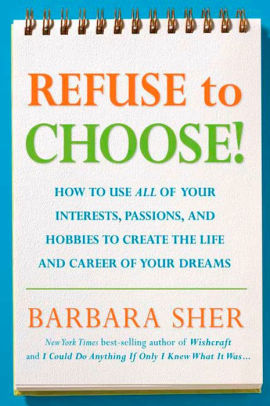
This is the third and probably last post related to Barbara Sher’s book Refuse to Choose (read my review).Today I’ll be discussing the idea of the Focus Board or the Rotating Priorities Board.
The Idea
The Focus Board is a very useful tool for multipods like me who have a basic set of interests that tend to cycle around. Yes, I have interests that come and go only once, but many of my hobbies are mainstays. The intensity of the interest I have for them will wax and wane, but these few have never dropped off the radar altogether.
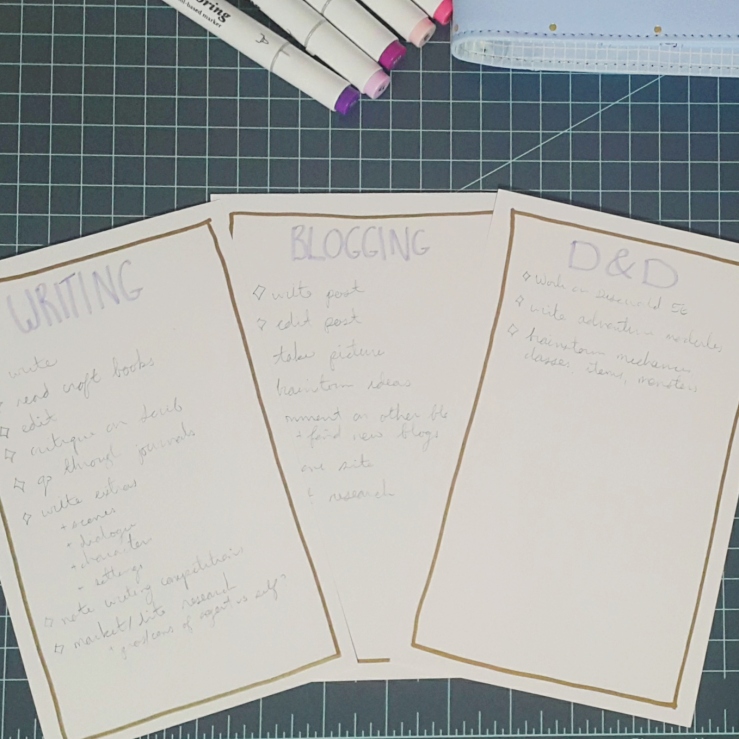
Currently, my Focus areas are; Writing, Crafting, D&D, and Blogging. Back when I first started the board, I had Health instead of D&D, but that’s changed over the last few months and so I’ve updated my board. That’s perfectly fine and exactly what this tool is supposed to do.
Why Rotate?
The reasoning is straightforward. You have several categories of things you’re interested in, and you want to make progress in each one, but if you try to schedule or focus on one until completion, you often find you can’t do that. A more specific example might be that you want to write a short story. That has steps and requires several days or weeks of solid work. You’re happy to do it, and it’s something you’re really interested in, but you have other things that occasionally creep up on your interest-o-meter (my word, bam).
The solution? Rotate.
In Practice
Let’s break it down further. I want to write a short story. I’m writing and all is fine and well until the third day when my interest begins to wane. Oh no, there goes that idea, I think to myself sadly, shelving the story as I move on to the paper dragon project that is so awesome I can’t stop thinking about it. Just at that moment, anyway.
But I don’t have to shelve the story. What I should do is put the “Writing” sheet underneath and put the “Crafting” sheet on top, work on the dragon until that interest fades, and then pick up the story again. If it’s been a really long time since I’ve written and I haven’t gotten the bug, there might be another issue than just interest. Maybe it wasn’t the story I needed to tell, or maybe writing isn’t my thing. That’s another issue for another post. This board is for things that DO come back around.
I always come back to writing, even if my interest wanes for a week or two. I always have a crafting project I’m doing at any given moment, be it knitting, paper craft, or bullet journaling (which I consider crafty). Lately, I’ve been creating and planning a lot of D&D related stuff, so I put that in, and blogging I keep separate from writing for my own purposes.
How to Make the Board
You can do this any way you want. In Korea, I made these really nice squares of colored paper that I pinned to my bulletin board at home.
On the top of each square I would write the title, like “Writing,” and under that I would list the things I could do to advance the goal I had for it.
In writing I might have; writing, reading how-to novels, novel research, editing, critiquing or reading others’ critiques. For blogging I have; write blog posts, edit existing drafts, take pictures, comment and network on other sites, and improve my site overall.
In crafting I have; knit, work on paper project, and make journal layouts. For D&D; write an adventure, work on my campaign, work on my characters for the games, watch DM how-tos online, and read the guidebooks.
Each of those things would help me work towards whatever goal I had in mind. You could make more concrete steps in a sequential order, or have only one or two or ten or twenty items you could do. It’s up to you and what your needs are.
You can have these as notes on your computer desktop, as physical paper on your wall or in a planner, or whatever works for you. I love this system because I have one up top prominently displayed that I’m very interested in at that moment, but if I lose interest, I move it out and move another up. There’s no guilt and there’s no pressure because I know it’ll come back around. For multipotentialites, forcing interest past its natural curve is nearly impossible, and often causes us to lose that interest altogether when it’s been tainted by guilt. So don’t do that.
I highly encourage you to try it. Even if making stuff isn’t your shizz, just making sticky notes on your computer that you’ll see when you start your day can be enough. It doesn’t have to be fancy. It just has to work for you.
If you give it a shot, let me know! What are your Focus areas?
After I first discovered I was a Multipotentialite, I read a lot of books about it. One of my favorites is Refuse to Chooseby Barbara Sher.
Multipotentialites, In Brief
A multipotentialite (Sher calls them Scanners*) is someone who has multiple, often disconnected interests.
And that’s it. The definition is pretty straightforward. Probably a lot more people are multipods than they realize. Of course, there’s a bit more to it than that, which is why reading books about it is such a good idea.
The Daybook
One of the first things Sher discusses is what she calls the “Daybook,” a journal, notebook, or other kind of writing thing that you, as a Scanner, can keep track of all your ideas and projects in.
It’s a fantastic idea, and I nearly stopped reading right then and there to leap up and make one!
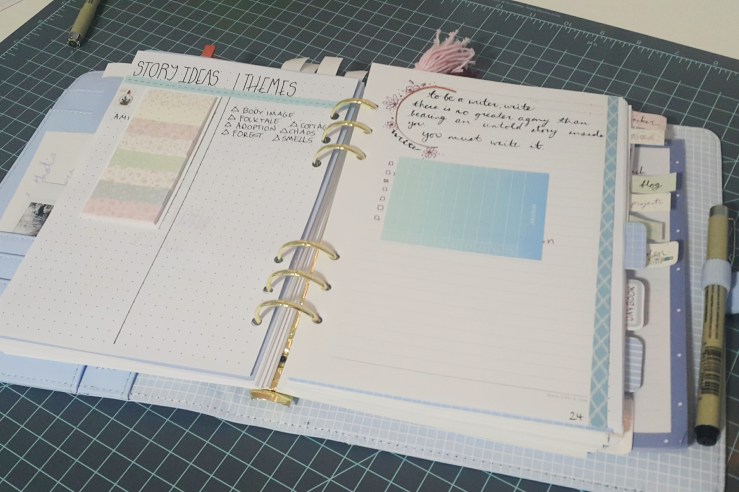
I did manage to finish the book first, but I have a Daybook section in my filofax now, and it’s been amazing.
Basically, whenever you, a Scanner, gets interested in something other than something you want to work on right then, you write and plan about it in your Daybook, using up at least two pages. You can draw, cut out pictures (who does that though, let’s be honest here), take notes, look up research, whatever it is. I have a page for my garden that’s waiting for Spring. Anytime I get the bug to garden but am currently unable to due to weather or other projects, I add a few more notes to my Daybook garden pages.
The point is not to clog up a notebook with things that will never be used. You may never get around to making that comedy podcast for kids. The point is to show that your ideas and interests have enough value to set down in writing – to pay attention to, even if it’s just for the space of two pages. And if you’re ever stuck with nothing to do, heaven help you, you can rediscover old interests through the Daybook.
I love this idea. I think most Scanners would. Part of my multipotentiality means I love planning and thinking about projects, but I hardly ever get around to following through with them. With the Daybook, I have more freedom and less guilt. I can write it out and leave it, if I want. I can come back to it later, if I want.
The Many Kinds of Scanners
We wish were as slick as this. (Photo from PCMag)
In Sher’s book, she talks about the kinds of Scanners. She divides the major groups into Cyclical Scanners and Sequential Scanners. Each chapter details the struggles of the type, accounts of people who have owned their type, and instructions on how to best utilize your type in work and life.
Cyclical Scanners
Cyclical Scanners have a pretty set list of interests that they rotate through fairly regularly. There’s no time limit on cycles, but you know that if you’re a science and history nerd, you probably won’t suddenly be infected by the desire to embroider.
First up is the Double Agent, someone who has really only two major interests. This can lead them to feeling like they live a “double” life. These kinds of Scanners often have fairly fulfilling day jobs that they’ve been at for some time, but have a dream (spend a year learning to cook in Rome, work with refugees abroad), and can’t figure out how to do both. Sher gives a wonderful exercise to help overcome this thinking and find creative ways to do what you want.
Secondly, we have the Sybil, someone who often has a lot of trouble because of the conflicting pull of all their interests, “but [who is] more concerned about having nothing to show for their lives” (Sher). This type of person rarely finishes a project completely before being pulled into the next one, and so feels they haven’t accumulated worth or are in danger of leaving behind no legacy. (For the record, I’m a Sybil. When Sher mentioned being surrounded by “creative clutter” and I looked around my apartment – heyo, bingo.) The biggest takeaway for Sybils is to schedule. This can sound terrifyingly limiting, but it’s just what someone who is pulled in so many directions will benefit from.
Finally, we have the Plate Spinner, and as you can probably guess, this is a Scanner who is able to keep several interests or projects going at once. These people generally enjoy challenges and coming up with creative solutions, and tend to like learning for practicality’s sake, not just the joy of it. You work fast and can move between projects easily. Problems arise when they’re so invested in helping others that they don’t get to work on their own projects, which can physically and mentally draining.
Sequential Scanners
A Sequential Scanner looks very different from a Cyclical Scanner at first glance. And indeed, many Sequential Scanners might not realize they are Scanners. These types do have varying interests, but they don’t return to them. “When they’re finished, they don’t look back” (Sher).
First up under this brand of Scanner is the Serial Specialist. Like the name implies, a Serial Specialist often spends several years at one job or with one project, deeply immersed to the exclusion of much else, and usually gains a lot of experience and expertise. These types can feel the same guilt as any other Scanner though; they might not stick with a job for more than a few years, and just when they’re getting up the corporate rung, they lose interest and jump to another job, causing plenty of people around them to scratch their heads and wonder. Sher has plenty of advice, not the least of which is finding an overarching theme to include the various interests as they come and go.
Next, we have the Serial Master, someone who, like the specialist, usually spends quite a while at one thing before moving on. The major difference is that the Master becomes, well, a master, going far in their field. It’s typically someone who enjoys being in the spotlight, making their company or brand better than they found it, and earning accolades or awards to show their hard work.
Sher makes a point of saying that every Scanner should try mastery of something, even those of us who aren’t Serial Masters or Specialists. For Sybils, Plate Spinners, and all the other Cyclical Scanners in between, it can be hard to have anything mastered on our lists. If you can’t find the time, Sher says to at least adopt the attitude of mastery, or giving something your all while you’re in it. I agree with that whole-heartedly.
Other Kinds of Scanners
Now we come to the Jack-of-All-Trades, a term many people have come to hate before they learn to embrace their multipotentiality. A Jack might have all manner of degrees and certificates, be adept at just about anything they try and feel they haven’t ever had a real passion for anything. A Jack may differ than other Scanners because they haven’t really pinpointed what they’re passionate about, where many other Scanners are concerned because there’s too much they’re passionate about! Sher’s advice for Jacks – keep doing what you’re doing. You may stumble across your passion or an amazing career, but straight-lacing yourself into one is definitely not the way to go.
Lastly, we have the Wanderer,someone who may appear on the surface much like a Jack, but rather than worrying about having a plan in life and failing to meet it, Wanderers are happy to drift between interests, wherever the winds may blow them. Sher really encourages the use of the Daybook here so Wanderers can understand the theme or overall direction of their wanderings.
These are just brief summations; if you recognized yourself at once, awesome! If not, read through each chapter to see what resonates with you. Sher often asks questions to help guide the reader to deeper understanding. There are a few more types I didn’t mention, mostly for brevity, so definitely check out the book for more information.
Careers and Life Models
One of the best things about this book is the sheer (ha, Sher) amount of information in it. The first section deals with the idea of Scanners as a whole subject, which is great if you’re still not sure you are one.
But the second section, where she talks about all the kinds of Scanners, gets really good. She gives an overview, shares stories of people who have struggled and overcome their own brand of Scanner-hood, and then gives models. There are various models like the Teacher Life Model, the Odysseus Life Model, the Umbrella Model, and more. Each type has a recommended list of life models they can choose from and specific instructions on how to apply their uniqueness to it.
It’s like a roadmap for your life! This is great for someone like me who has always worried about inserting my interests into my career or just doesn’t realize there all these options for how to live life.
For me, I had huge problems all my life about the idea of a career. I fought against the idea of an office job tooth-and-nail. I fought against being a teacher until the rest of my life looked me in the eyes and I had to pick something, and just then teaching didn’t look so bad.
But the worst thought of all was doing the same thing for the rest of my life…and it might not be the right thing! Searching for the “one” career that would suit me as passionately as many search for the lifelong, single soulmate, I went from interest to interest, getting increasingly fed up until I finally came to a place of despair over the rest of my life. I didn’t trust myself anymore. I thought I had no guts to find the right job and stick with it. I thought that everyone else must feel like me about their chosen profession, but had somehow muscled through the burnout and kept on doing something they hated while more interesting things flew by.
No, I’m just a Scanner. You’re a Scanner, if you’ve had this same problem. A career, as defined by tradition, probably won’t do. Your life won’t look like the traditional life. People will ask, coyly at first, then with more worry as you get older, when you’re going to settle down, stop moving about, stop changing jobs, get a real job, or any job. And each remark will be a chip in your self-worth, a small indictment that you aren’t as human, as hardworking, as ethical, as successful, as whatever as the idea of a worker is. You, and I, will have to fight this flaking of value every day, every time our interests change, and it will be very hard some days, when your friends are getting promotions and moving up and making a lot more money and seem really happy, and you are stuck wondering why you can’t just suck it up and do that.
I’m getting down just thinking like that. That view of life is not true. It’s not. We are not like that. We are not more valuable, or less. We are different. There are a lot of us, some hiding in those real jobs, and some not. We live differently. And that is not wrong. I tell myself this all the time. It is not wrong.
And Sher’s models for different career types was totally eye-opening. It’s like knowing someone invented a doorknob. I mean, hello, of course, that’s so obvious! But I never thought of it!
Personal Experience
One thing that makes many Scanners uneasy about themselves is how often they fail to see through a hobby or project to the end.
I found this to be true in my own case. I got into woodworking hardcore for a couple of weeks, looking up videos and reading books, and was finally able to get the tools around Christmas. I was over the moon about the neat roll-up of carving tools, and the long bit of balsa to carve. Maybe it wasn’t balsa – that stuff is soft. Anyway. I had my stuff, I was all ready to go, and off I went. To carve…half a duck. Yeah, just half. Then I was done. Love affair over, and I didn’t have anything to show for it. I threw the wood away after a while and sold the tools in a garage sale, I think.
I was ashamed about that for a while, and I wondered as I was reading Sher’s book, what was my reward then? Did I psyche myself out by thinking too much of the finished project? Did I get my satisfaction from the videos, the books, the planned projects, and the brief bit of tactile play? What then, was the real reward? Perhaps just knowing that I had done it. The knowledge that I had turned a piece of wood in my hands and made those cuts at the right angle, according to the books.
If I had to say, I think my reward is often vision; planning things, imagining the possibilities, picturing a life with whatever in it. It might not always be vision; it could be beauty, experience, sensation, creation, expression…but whatever I get out of something, I don’t feel guilty anymore about not “finishing” according to someone else’s idea of what finishing looks like. I call my woodworking a success where most people wouldn’t. But I won’t let them judge.
Finally, Check Your Feelings
Sher makes a point to remind Scanners to check their feelings regularly. Since most of our interests stem from passion, and that passion and subsequent lack of passion often fuel guilt, she says it’s important to figure out how we feel about things and to validate those feelings.
I love this idea (I did a whole “how do I want to feel” course courtesy of Danielle LaPorte). I think for Scanners, we fluctuate between so many emotions, so many ups and downs, that we start to put aside our feelings for the sake of loyalty or duty or being grown-up; and that’s a recipe for disaster and heartache.
If you’re hurting, say “ouch.” If you’re in love with something, be in love with it. If the interest wanes, be grateful to it and let it go (this is for interests, mind; Sher does point out that some things in our lives require commitment through tough times – family, health, etc.).
Guilt
A feeling many Scanners deal with regularly is guilt. Guilty because they can’t settle. Guilty because they can’t stick something out or hold down one job. Guilty because they spent so much money on a new hobby only to lose all interest after a couple of weeks (hello). Guilty because they didn’t see a new hobby through to the end (didn’t carve anything to keep).
Guilt is terrible. Guilt is the feeling that we have failed in some way; against someone’s expectations, against our morals, against the image we have of ourselves. It’s also wrong, in most of the above cases. It’s the same class of guilt we get when we choose a job or loved one our family doesn’t approve of. It hurts, but ultimately it’s our choice, and to go with others’ desires would make us miserable. Objectively, we know that to be the case. Subjectively, it can be devastatingly hard to go against the flow.
Many creative people struggle with this. It’s a classic stereotype that artists must rail against parents to fulfill their dreams, or bankers must rail against artistic parents to work on Wall Street.
Watch out for guilt. Watch out for feeling that there is a “correct” and “best” way to live your life, as funneled to you by parents, friends, society, or your ideas. Go in the direction of your interests without guilt.
—
Refuse to Choose has a lot more to offer. It’s a dense book packed with practical advice on following up on dreams. She talks about backward flow charts and team meetings to brainstorm ideas, how to find the common theme of seemingly disparate ideas, and way, way more. I can’t recommend it enough. I mean, I just wrote a three-thousand-word review of it.
Sher’s book is like a big hug for Scanners. It’s a huge affirmation of what you are, how you live your life, and it has a lot of practical advice too. I highly recommend it to anyone who suspects they might be a multipotentialite or needs clarification or just wants some really fun ideas on what to do next!
*Multipotentialite is the word I first heard to understand the term, so that’s what I use when I feel like I need to be official about it. Different people use different words. I’ve heard multipod as well, renaissance person, jack-of-all-trades, and as Sher uses in her book, Scanner.
**I talk more about what Multipotentialiates are, the stigma around them, and how awful it can be living life thinking there’s something wrong with you here.





 A.M. EDMONSON