Changing the Storyline of Your Life for Better Living

Change the storyline of your life to live a better story.

I heard this idea in my meditation practice. We go through life telling ourselves stories about who we are, what we do, and how we live. I imagine they call it a story because even though there is a reality and therefore a truth to it, there’s no way we can know the whole truth of ourselves, others, or any situation. There are always going to be factors that remain unknown.

So, then, we create a story. I am a victim. I am powerful. I am no good. I am destined for failure. No one likes me. Everyone likes me. The story can be good or bad, but mostly, we’re talking about the bad stories of our lives. Those are the ones we want to change.

For me, I had one story about myself for most of my life; I lived thinking I was in control, cool, intelligent, put together, sensible, and fun. Back when I first started having stress-related health issues, they didn’t fit my story. (I also tested as an INTJ back then, and false or otherwise, it definitely colored my perception of myself.) I didn’t let anyone know I was having stress issues or that I was depressed because I didn’t see myself as a person that happened to. The story went that depressed people weren’t trying hard enough, didn’t read books showing them how to have a better mindset, and wanted attention.

I was lucky to get better at all with all that crap in my head. Well, better-ish, since the whole thing happened again a few months ago. This time (over several years) my story had changed. I had slowly come around to accepting myself as an INFJ, an HSP, a multipotentialite, and more creative and dreamy than hardass and intellectual. I was sensitive, and now my sensitivity had taken a blow. But I still thought it was on me. I still thought I hadn’t done something right or I hadn’t taken good enough care of myself. That’s probably true, but it put me in the mindset of victimization. All these external factors had contributed to my fall. It was the school’s fault, it was my friend’s fault, it was my doctor’s fault, it was God’s fault, it was my fault, etc.

Who cares? It doesn’t matter how it happened. It happened, so what am I going to do about it? Thinking about where the blame falls is not only toxic in that it’s automatically negative, but it also keeps the focus on the problem, instead of on the possible solutions.

One foot in front of the other. I can’t see three feet ahead, just the next step, so move there. And then there. And then there. Forward, forward…

The above is a kind of mantra I go through when I’m terrified of what’s next. I don’t know where to go. I knew in college, I had a general idea in Korea, but now…there is nothing ahead of me. It’s a fog, and I can only put one foot ahead. Go to the doctor. See a psychiatrist. Eat better. Exercise to keep me healthy. Get my mind healthy. Find positive friends who support and challenge me. Find a healthy church group. Find a writing group.

The story is changing around me, but I’m not a useless bystander. I can direct it.

Instead of I am a sick person –> I am a recovering person.

Instead of I am not in control of my life –> I can make decisions that influence my life.

Instead of I must be successful/financially stable –> I can determine what is enough for my life.

Instead of I have to be a published author to be worthy –> I am enough.

Instead of I am a burden when I’m sick –> I am worthy of being helped.

Instead of I am someone with a depressing past/history of abuse –> I am able to be better/I can share my story to help others.

You can see how valuable this is. It’s not just positive thinking. It’s changing how you view your entire self in terms of your life. Really, this is best for getting over a mindset of helplessness. Too many people who are victims of abuse, depression, chronic illness, or other really and truly debilitating problems let themselves lose control over their lives and continue to live out the story of their problem. I’m one of them, so I would know.

But I also know that it’s not the only truth. As many people I know who are this way, there are so many stories of people who have overcome awful situations with hope and determination and totally changed their own storylines.

Some of the most well-known examples; Viktor Frankl, Martina Stawski, Nick Vujicic, and Joni Tada.

Change the story of you in your head, and you can change your life.*
Signature


*I want to be clear – if you do have depression, anxiety, or have suffered trauma or abuse, positive thinking and this sort of advice will only do so much. I always encourage you to see a doctor or psychiatrist first. They are trained professionals. The sort of advice I give on this blog is more general. 🙂
 

a poem: cornflower

Noticing the blue sky above your head
Dotted with puffs of white cloud
Is very cliche
But I did it anyway
And had a revelation
That cliches may be cliche
But what makes them bad?
I saw the blue sky
I saw the clouds
I saw all the way to heaven
More or less
I saw that around the sun the sky was bleached blue,
Pale blue
And pale blue
Around the horizon
But upwards above me, and for some reason
In a spot away to my right,
It was a deeper blue
So blue, like what the crayola people call
Cornflower blue
And it nearly struck me speechless
I wish I had been alone to just look
Forever into cornflower blue
Instead I looked down
And felt the wind on my face
And saw the weeds coming up
Under my mother’s hands
And into the big green trash bin.
Life is amazing.

-a.e

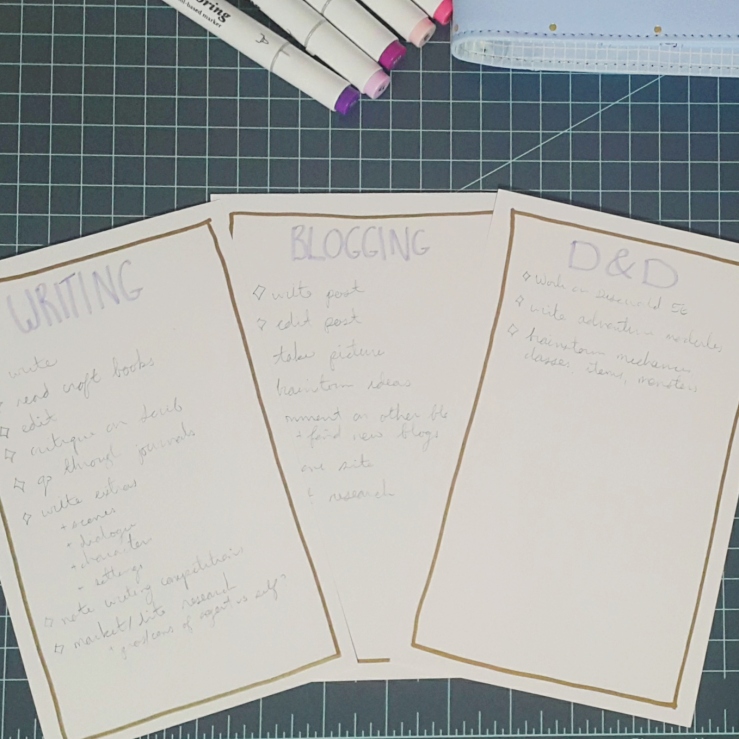
Rotating Priorities Board: Multipotentialite Series

Processed with VSCO with  preset
I made much prettier ones in Korea, but you get the idea.


This is the third and probably last post related to Barbara Sher’s book Refuse to Choose (read my review). Today I’ll be discussing the idea of the Focus Board or the Rotating Priorities Board.

The Idea

The Focus Board is a very useful tool for multipods like me who have a basic set of interests that tend to cycle around. Yes, I have interests that come and go only once, but many of my hobbies are mainstays. The intensity of the interest I have for them will wax and wane, but these few have never dropped off the radar altogether.

Currently, my Focus areas are; Writing, Crafting, D&D, and Blogging. Back when I first started the board, I had Health instead of D&D, but that’s changed over the last few months and so I’ve updated my board. That’s perfectly fine and exactly what this tool is supposed to do.

Why Rotate?

The reasoning is straightforward. You have several categories of things you’re interested in, and you want to make progress in each one, but if you try to schedule or focus on one until completion, you often find you can’t do that. A more specific example might be that you want to write a short story. That has steps and requires several days or weeks of solid work. You’re happy to do it, and it’s something you’re really interested in, but you have other things that occasionally creep up on your interest-o-meter (my word, bam).

The solution? Rotate.

In Practice

Let’s break it down further. I want to write a short story. I’m writing and all is fine and well until the third day when my interest begins to wane. Oh no, there goes that idea, I think to myself sadly, shelving the story as I move on to the paper dragon project that is so awesome I can’t stop thinking about it. Just at that moment, anyway.

But I don’t have to shelve the story. What I should do is put the “Writing” sheet underneath and put the “Crafting” sheet on top, work on the dragon until that interest fades, and then pick up the story again. If it’s been a really long time since I’ve written and I haven’t gotten the bug, there might be another issue than just interest. Maybe it wasn’t the story I needed to tell, or maybe writing isn’t my thing. That’s another issue for another post. This board is for things that DO come back around.

I always come back to writing, even if my interest wanes for a week or two. I always have a crafting project I’m doing at any given moment, be it knitting, paper craft, or bullet journaling (which I consider crafty). Lately, I’ve been creating and planning a lot of D&D related stuff, so I put that in, and blogging I keep separate from writing for my own purposes.

How to Make the Board

You can do this any way you want. In Korea, I made these really nice squares of colored paper that I pinned to my bulletin board at home.

On the top of each square I would write the title, like “Writing,” and under that I would list the things I could do to advance the goal I had for it.

In writing I might have; writing, reading how-to novels, novel research, editing, critiquing or reading others’ critiques. For blogging I have; write blog posts, edit existing drafts, take pictures, comment and network on other sites, and improve my site overall.

In crafting I have; knit, work on paper project, and make journal layouts. For D&D; write an adventure, work on my campaign, work on my characters for the games, watch DM how-tos online, and read the guidebooks.

Each of those things would help me work towards whatever goal I had in mind. You could make more concrete steps in a sequential order, or have only one or two or ten or twenty items you could do. It’s up to you and what your needs are.

You can have these as notes on your computer desktop, as physical paper on your wall or in a planner, or whatever works for you. I love this system because I have one up top prominently displayed that I’m very interested in at that moment, but if I lose interest, I move it out and move another up. There’s no guilt and there’s no pressure because I know it’ll come back around. For multipotentialites, forcing interest past its natural curve is nearly impossible, and often causes us to lose that interest altogether when it’s been tainted by guilt. So don’t do that.

I highly encourage you to try it. Even if making stuff isn’t your shizz, just making sticky notes on your computer that you’ll see when you start your day can be enough. It doesn’t have to be fancy. It just has to work for you.

If you give it a shot, let me know! What are your Focus areas?

Signature


a poem: burn scars

If you have a burn scar
No one asks why you’re afraid of fire
No one asks why you shy away
Why you’re careful
Why even a candle can be
Terrifying
I have been burned by love
So even a small consideration
A small touch
A small notice
Is terrifying
Objectively
(How we overuse that word)
Burn victims know all fire is not bad
Fire gives warmth
Energy
Cleansing
Love victims know love gives too
Comfort
Support
Otherness nearby
Twin toothbrushes
But just as that burn victim needs time
So we need time
Not more fish in the ocean talk
Not you haven’t met the right one talk
Not get over it talk
Just time
Just practice
Just more small candles
That do not burn
A candle that reaches out
To caress
To chase gently
Oh so gently
To fish me out of the crevice where I
Hide licking my
Wounds
I have been burned
But you don’t see my scars
So to you
They are invisible
Like children playing tag
Hiding their eyes
So they don’t see you
You don’t see them
Same you turn from me
Refusing to see my scars
Well love is like that
Love can be the best thing
In the whole world
Or it can leave us in the ICU
Skin flayed wrinkled parched dying sloughing off
Until we are unrecognizable
My heart is so
Treat me gently
But find me a lover anyway
I am freezing for fear of fire

-a.e

Life Accomplishments: Multipotentialite Series

This is another post inspired by Barbara Sher’s book Refuse to Choose. I’ll be doing a few of these, as it’s one of my favorite books for multipotentialites, and it has so much practical advice.

In the book, she asks readers to make a list of everything they’ve done in their lives (read my review).

The reason is that many multipotentialites, by nature unable to settle down to one thing, often reach a point in their lives when they feel as though they haven’t really accomplished anything. While friends have gone smoothly up the corporate ladder, or smoothly down the homemaking trail, or smoothly into whatever field they’ve loved forever, for mutlipotentialites, our patchwork lives can seem…lacking.

I made my list, and it was a great exercise in reality. I’ve often felt that my life has been very piecemeal; this bit here, that bit there, this interest over here, but nothing connected, nothing coherent.

My timeline of accomplishments will never be coherent (hallelujah), but it does help me realize that I have actually done a lot in my life.

  • Painted my own storybook and table set (to match, aww)
  • Made jewelry
  • Made baby clothes
  • Made dolls (knit, waldorf, felt) and doll clothes
  • Knit a blanket for my neighbor
  • Knit a sweater for my mom
  • Won prizes for equestrian showmanship and Western riding
  • Learned to ride Western and English
  • Learned to jump
  • Learned etiquette at Cotillion
  • Learned to dance (waltz, foxtrot, jitterbug, swing, Charleston, English Country)
  • Knit mug cozies, scarves, gloves, socks, hats
  • Embroidered bags
  • Cross-stitched
  • Placed in an art show in high school
  • Taught in Taiwan
  • Volunteered at a therapeutic horse riding center and won an award
  • Wrote a novel
  • Played D&D (a performance feat if ever there was one)
  • DMed Dungeons and Dragons
  • Began woodworking
  • Made natural beauty products
  • Made herbal medicine
  • Learned Chinese and Korean
  • Learned basic Swedish
  • Drew comics
  • Traveled to Russia, New Zealand, and around the US
  • Taught in Korea
  • Designed a car with my friend in middle school
  • Made a pinhole camera
  • Developed pictures myself (from negatives in a chem bath)
  • Learned HTML/CSS
  • Graduated college Summa Cum Laude
  • Got a promotion
  • Learned to tat
  • Got the highest score on my AP art portfolio
  • Made several fantasy/sci-fi/medieval costumes
  • Sewed clothing
  • Made a quilt
  • Painted portraits
  • Owned horses
  • Made scrapbooks/art/bullet journals
  • Cut paper art

This list is like a love letter to myself, gently reminding me that yes, I have done things with my life. Yes, I have used my time well. I’m young, objectively speaking, but it’s hard for anyone over 12 to feel objective when 12- and 13-year-olds (or even younger, who am I kidding?), routinely do incredibly amazing things in art and science and performance. It’s hard, but it’s necessary. Just because I didn’t publish my first book at 10 doesn’t mean I’m not a good writer. There’s no correct or best timeline for anyone.

If you’ve ever struggled with feeling like you’ve never done anything, make your own list. Include books you’ve read or games you’ve played or places you’ve lived or people you’ve met. Those are all accomplishments. And big or small, they are important.

Signature