Have you ever heard the phrase “just be yourself?” I’m positive you have. If not said directly to you, then in a book or on TV, always given as advice on how to overcome shyness or anxiety. How to survive at a party or on a first date. How to make friends the first day of school. How to ace an interview.
But in this talk, Caroline McHugh points out that being yourself is hard work. And nobody is “just” anything. Just implies that it’s so easy, so little, so meager to be yourself, when really it’s the journey of a lifetime to even figure out what that is.
Yourself is hard work. Yourself free of others’ expectations of you, of your own expectations, of how you were raised and the people who surround you, is hard. We need to give a little more grace to the process and a little more honor. Being yourself is the goal in life, and if you can say that you are yourself unabashedly, that’s a cause for celebration.
McHugh also invites us to ask not what our life expectancy is but what do we expect of life. She points out that that is a much more interesting question and one that will help us uncover who we are.
Who we are, in being ourselves, is well represented by an hourglass. At the beginning and the end of our lives, we are the best at being ourselves. Kids run around and play and goof off with very little awareness of themselves or what people think, and we all know the stereotype of the elderly being crotchety and outspoken. What I love is that McHugh says that when you realize you have more summers behind you than in front of you, you become more honest because you just can’t be arsed to care about anybody else’s opinion.
The bit in the middle is more problematic, when we’re squeezed by society’s pressures and have to accommodate and adapt and live up to other people’s expectations.
In the middle of her talk, McHugh dives into her idea of an interiority complex, presented in contrast to the inferiority and superiority complexes. An interiority complex is entirely unrelative to others. It’s a vantage point and orientation where you have no competition. Contrast that with the idea of superior/inferior mindsets that depend on others to exist (superior – I am better than those around me, inferior – I am worse than those around me).
Remember what Jill Scott said about queendom (paraphrase): “Mine can never compare to hers and hers can never compare to mine. We all come with our own strengths.” This is such an important mindset to have, and one we try to teach ourselves and our students and our kids, but again and again we find it so difficult.
When you think about your identity, you’re not your thoughts, you’re not your feelings (because who’s feeling them), you’re not what you do, there’s something underneath it all that is the real you. Growing up, growing old, growing out; it’s all a way to figure out what that person deep inside is.
McHugh mentions the blue sky, which caught my attention because it’s such a prominent idea in my meditation practice. The sky doesn’t’ boast or complain about it’s weather, it knows the impermanence of the storms and the sunsets and the permanence of the blue sky.
I think the advice of this talk can best be summed up in these words; don’t live someone else’s opinion of you. Find it for yourself and be honest. Be you.
I am a writer. I write. I want to be an Author. A published writer. I don’t know if everyone would agree with the distinction, but I like it.
I didn’t always seriously want to be one. I mean, I dabbled in wanting to be one, all the while feverishly writing something every year, whether it was a story, a blog, or a journal, but I only decided a couple of years ago.
In fact, it was just after I finished my first NaNo month in 2015. I’d just moved to Korea, had no hobbies or friends, and decided to use all my spare time that November to see if I could finish a story. I’d never done that before. My computers and notebooks were full of scenes and half-finished stories, but I had never finished one. So I tried, and did it.
After that, it was a short jog from realizing I could finish a story to deciding I’d like to keep finishing stories for the rest of my life.
After I realized I was a multipotentialite, the dream expanded a bit to allow for other things around it, but writing has always been my main passion.
Then began the real work. In the two years since deciding, I’ve written one more book and started countless others, I’ve gotten a LOT better at it, I’ve read books on writing and books about writers, and I’ve kept up a journal and this blog to keep me writing even when I’m not working on a story.
I hope to publish soon, some kind of small fantasy story that won’t be extremely good but will be PUBLISHED. Then that hurdle will be over and I can move on to the next story, which will be better, and so on and forever.
I’m declaring it now. I want to be an Author. I don’t care about being famous, or making lots of money. I am putting my bar low. I want to be published on Amazon and have my name on a website under a book title. I want to be able to tell people, “Yeah, I’ve published a book. Yeah, it’s called…”
Change the storyline of your life to live a better story.
I heard this idea in my meditation practice. We go through life telling ourselves stories about who we are, what we do, and how we live. I imagine they call it a story because even though there is a reality and therefore a truth to it, there’s no way we can know the whole truth of ourselves, others, or any situation. There are always going to be factors that remain unknown.
So, then, we create a story. I am a victim. I am powerful. I am no good. I am destined for failure. No one likes me. Everyone likes me. The story can be good or bad, but mostly, we’re talking about the bad stories of our lives. Those are the ones we want to change.
For me, I had one story about myself for most of my life; I lived thinking I was in control, cool, intelligent, put together, sensible, and fun. Back when I first started having stress-related health issues, they didn’t fit my story. (I also tested as an INTJ back then, and false or otherwise, it definitely colored my perception of myself.) I didn’t let anyone know I was having stress issues or that I was depressed because I didn’t see myself as a person that happened to. The story went that depressed people weren’t trying hard enough, didn’t read books showing them how to have a better mindset, and wanted attention.
I was lucky to get better at all with all that crap in my head. Well, better-ish, since the whole thing happened again a few months ago. This time (over several years) my story had changed. I had slowly come around to accepting myself as an INFJ, an HSP, a multipotentialite, and more creative and dreamy than hardass and intellectual. I was sensitive, and now my sensitivity had taken a blow. But I still thought it was on me. I still thought I hadn’t done something right or I hadn’t taken good enough care of myself. That’s probably true, but it put me in the mindset of victimization. All these external factors had contributed to my fall. It was the school’s fault, it was my friend’s fault, it was my doctor’s fault, it was God’s fault, it was my fault, etc.
Who cares? It doesn’t matter how it happened. It happened, so what am I going to do about it? Thinking about where the blame falls is not only toxic in that it’s automatically negative, but it also keeps the focus on the problem, instead of on the possible solutions.
One foot in front of the other. I can’t see three feet ahead, just the next step, so move there. And then there. And then there. Forward, forward…
The above is a kind of mantra I go through when I’m terrified of what’s next. I don’t know where to go. I knew in college, I had a general idea in Korea, but now…there is nothing ahead of me. It’s a fog, and I can only put one foot ahead. Go to the doctor. See a psychiatrist. Eat better. Exercise to keep me healthy. Get my mind healthy. Find positive friends who support and challenge me. Find a healthy church group. Find a writing group.
The story is changing around me, but I’m not a useless bystander. I can direct it.
Instead of I am a sick person –> I am a recovering person.
Instead of I am not in control of my life –> I can make decisions that influence my life.
Instead of I must be successful/financially stable –> I can determine what is enough for my life.
Instead of I have to be a published author to be worthy –> I am enough.
Instead of I am a burden when I’m sick –> I am worthy of being helped.
Instead of I am someone with a depressing past/history of abuse –> I am able to be better/I can share my story to help others.
You can see how valuable this is. It’s not just positive thinking. It’s changing how you view your entire self in terms of your life. Really, this is best for getting over a mindset of helplessness. Too many people who are victims of abuse, depression, chronic illness, or other really and truly debilitating problems let themselves lose control over their lives and continue to live out the story of their problem. I’m one of them, so I would know.
But I also know that it’s not the only truth. As many people I know who are this way, there are so many stories of people who have overcome awful situations with hope and determination and totally changed their own storylines.
Change the story of you in your head, and you can change your life.*
*I want to be clear – if you do have depression, anxiety, or have suffered trauma or abuse, positive thinking and this sort of advice will only do so much. I always encourage you to see a doctor or psychiatrist first. They are trained professionals. The sort of advice I give on this blog is more general. 🙂
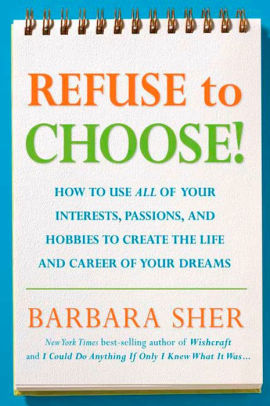
This is another post inspired by Barbara Sher’s book Refuse to Choose. I’ll be doing a few of these, as it’s one of my favorite books for multipotentialites, and it has so much practical advice.
In the book, she asks readers to make a list of everything they’ve done in their lives (read my review).
The reason is that many multipotentialites, by nature unable to settle down to one thing, often reach a point in their lives when they feel as though they haven’t really accomplished anything. While friends have gone smoothly up the corporate ladder, or smoothly down the homemaking trail, or smoothly into whatever field they’ve loved forever, for mutlipotentialites, our patchwork lives can seem…lacking.
I made my list, and it was a great exercise in reality. I’ve often felt that my life has been very piecemeal; this bit here, that bit there, this interest over here, but nothing connected, nothing coherent.
My timeline of accomplishments will never be coherent (hallelujah), but it does help me realize that I have actually done a lot in my life.
Painted my own storybook and table set (to match, aww)
Made jewelry
Made baby clothes
Made dolls (knit, waldorf, felt) and doll clothes
Knit a blanket for my neighbor
Knit a sweater for my mom
Won prizes for equestrian showmanship and Western riding
Learned to ride Western and English
Learned to jump
Learned etiquette at Cotillion
Learned to dance (waltz, foxtrot, jitterbug, swing, Charleston, English Country)
Knit mug cozies, scarves, gloves, socks, hats
Embroidered bags
Cross-stitched
Placed in an art show in high school
Taught in Taiwan
Volunteered at a therapeutic horse riding center and won an award
Wrote a novel
Played D&D (a performance feat if ever there was one)
DMed Dungeons and Dragons
Began woodworking
Made natural beauty products
Made herbal medicine
Learned Chinese and Korean
Learned basic Swedish
Drew comics
Traveled to Russia, New Zealand, and around the US
Taught in Korea
Designed a car with my friend in middle school
Made a pinhole camera
Developed pictures myself (from negatives in a chem bath)
Learned HTML/CSS
Graduated college Summa Cum Laude
Got a promotion
Learned to tat
Got the highest score on my AP art portfolio
Made several fantasy/sci-fi/medieval costumes
Sewed clothing
Made a quilt
Painted portraits
Owned horses
Made scrapbooks/art/bullet journals
Cut paper art
This list is like a love letter to myself, gently reminding me that yes, I have done things with my life. Yes, I have used my time well. I’m young, objectively speaking, but it’s hard for anyone over 12 to feel objective when 12- and 13-year-olds (or even younger, who am I kidding?), routinely do incredibly amazing things in art and science and performance. It’s hard, but it’s necessary. Just because I didn’t publish my first book at 10 doesn’t mean I’m not a good writer. There’s no correct or best timeline for anyone.
If you’ve ever struggled with feeling like you’ve never done anything, make your own list. Include books you’ve read or games you’ve played or places you’ve lived or people you’ve met. Those are all accomplishments. And big or small, they are important.
After I first discovered I was a Multipotentialite, I read a lot of books about it. One of my favorites is Refuse to Chooseby Barbara Sher.
Multipotentialites, In Brief
A multipotentialite (Sher calls them Scanners*) is someone who has multiple, often disconnected interests.
And that’s it. The definition is pretty straightforward. Probably a lot more people are multipods than they realize. Of course, there’s a bit more to it than that, which is why reading books about it is such a good idea.
The Daybook
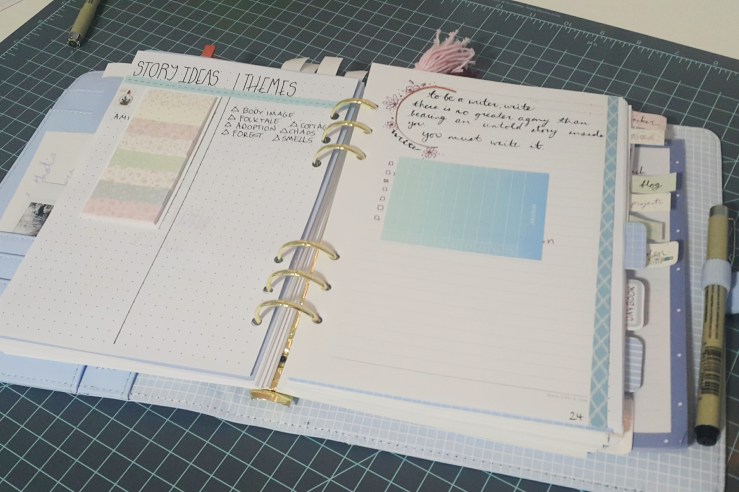
One of the first things Sher discusses is what she calls the “Daybook,” a journal, notebook, or other kind of writing thing that you, as a Scanner, can keep track of all your ideas and projects in.
It’s a fantastic idea, and I nearly stopped reading right then and there to leap up and make one!
I did manage to finish the book first, but I have a Daybook section in my filofax now, and it’s been amazing.
Basically, whenever you, a Scanner, gets interested in something other than something you want to work on right then, you write and plan about it in your Daybook, using up at least two pages. You can draw, cut out pictures (who does that though, let’s be honest here), take notes, look up research, whatever it is. I have a page for my garden that’s waiting for Spring. Anytime I get the bug to garden but am currently unable to due to weather or other projects, I add a few more notes to my Daybook garden pages.
The point is not to clog up a notebook with things that will never be used. You may never get around to making that comedy podcast for kids. The point is to show that your ideas and interests have enough value to set down in writing – to pay attention to, even if it’s just for the space of two pages. And if you’re ever stuck with nothing to do, heaven help you, you can rediscover old interests through the Daybook.
I love this idea. I think most Scanners would. Part of my multipotentiality means I love planning and thinking about projects, but I hardly ever get around to following through with them. With the Daybook, I have more freedom and less guilt. I can write it out and leave it, if I want. I can come back to it later, if I want.
The Many Kinds of Scanners
We wish were as slick as this. (Photo from PCMag)
In Sher’s book, she talks about the kinds of Scanners. She divides the major groups into Cyclical Scanners and Sequential Scanners. Each chapter details the struggles of the type, accounts of people who have owned their type, and instructions on how to best utilize your type in work and life.
Cyclical Scanners
Cyclical Scanners have a pretty set list of interests that they rotate through fairly regularly. There’s no time limit on cycles, but you know that if you’re a science and history nerd, you probably won’t suddenly be infected by the desire to embroider.
First up is the Double Agent, someone who has really only two major interests. This can lead them to feeling like they live a “double” life. These kinds of Scanners often have fairly fulfilling day jobs that they’ve been at for some time, but have a dream (spend a year learning to cook in Rome, work with refugees abroad), and can’t figure out how to do both. Sher gives a wonderful exercise to help overcome this thinking and find creative ways to do what you want.
Secondly, we have the Sybil, someone who often has a lot of trouble because of the conflicting pull of all their interests, “but [who is] more concerned about having nothing to show for their lives” (Sher). This type of person rarely finishes a project completely before being pulled into the next one, and so feels they haven’t accumulated worth or are in danger of leaving behind no legacy. (For the record, I’m a Sybil. When Sher mentioned being surrounded by “creative clutter” and I looked around my apartment – heyo, bingo.) The biggest takeaway for Sybils is to schedule. This can sound terrifyingly limiting, but it’s just what someone who is pulled in so many directions will benefit from.
Finally, we have the Plate Spinner, and as you can probably guess, this is a Scanner who is able to keep several interests or projects going at once. These people generally enjoy challenges and coming up with creative solutions, and tend to like learning for practicality’s sake, not just the joy of it. You work fast and can move between projects easily. Problems arise when they’re so invested in helping others that they don’t get to work on their own projects, which can physically and mentally draining.
Sequential Scanners
A Sequential Scanner looks very different from a Cyclical Scanner at first glance. And indeed, many Sequential Scanners might not realize they are Scanners. These types do have varying interests, but they don’t return to them. “When they’re finished, they don’t look back” (Sher).
First up under this brand of Scanner is the Serial Specialist. Like the name implies, a Serial Specialist often spends several years at one job or with one project, deeply immersed to the exclusion of much else, and usually gains a lot of experience and expertise. These types can feel the same guilt as any other Scanner though; they might not stick with a job for more than a few years, and just when they’re getting up the corporate rung, they lose interest and jump to another job, causing plenty of people around them to scratch their heads and wonder. Sher has plenty of advice, not the least of which is finding an overarching theme to include the various interests as they come and go.
Next, we have the Serial Master, someone who, like the specialist, usually spends quite a while at one thing before moving on. The major difference is that the Master becomes, well, a master, going far in their field. It’s typically someone who enjoys being in the spotlight, making their company or brand better than they found it, and earning accolades or awards to show their hard work.
Sher makes a point of saying that every Scanner should try mastery of something, even those of us who aren’t Serial Masters or Specialists. For Sybils, Plate Spinners, and all the other Cyclical Scanners in between, it can be hard to have anything mastered on our lists. If you can’t find the time, Sher says to at least adopt the attitude of mastery, or giving something your all while you’re in it. I agree with that whole-heartedly.
Other Kinds of Scanners
Now we come to the Jack-of-All-Trades, a term many people have come to hate before they learn to embrace their multipotentiality. A Jack might have all manner of degrees and certificates, be adept at just about anything they try and feel they haven’t ever had a real passion for anything. A Jack may differ than other Scanners because they haven’t really pinpointed what they’re passionate about, where many other Scanners are concerned because there’s too much they’re passionate about! Sher’s advice for Jacks – keep doing what you’re doing. You may stumble across your passion or an amazing career, but straight-lacing yourself into one is definitely not the way to go.
Lastly, we have the Wanderer,someone who may appear on the surface much like a Jack, but rather than worrying about having a plan in life and failing to meet it, Wanderers are happy to drift between interests, wherever the winds may blow them. Sher really encourages the use of the Daybook here so Wanderers can understand the theme or overall direction of their wanderings.
These are just brief summations; if you recognized yourself at once, awesome! If not, read through each chapter to see what resonates with you. Sher often asks questions to help guide the reader to deeper understanding. There are a few more types I didn’t mention, mostly for brevity, so definitely check out the book for more information.
Careers and Life Models
One of the best things about this book is the sheer (ha, Sher) amount of information in it. The first section deals with the idea of Scanners as a whole subject, which is great if you’re still not sure you are one.
But the second section, where she talks about all the kinds of Scanners, gets really good. She gives an overview, shares stories of people who have struggled and overcome their own brand of Scanner-hood, and then gives models. There are various models like the Teacher Life Model, the Odysseus Life Model, the Umbrella Model, and more. Each type has a recommended list of life models they can choose from and specific instructions on how to apply their uniqueness to it.
It’s like a roadmap for your life! This is great for someone like me who has always worried about inserting my interests into my career or just doesn’t realize there all these options for how to live life.
For me, I had huge problems all my life about the idea of a career. I fought against the idea of an office job tooth-and-nail. I fought against being a teacher until the rest of my life looked me in the eyes and I had to pick something, and just then teaching didn’t look so bad.
But the worst thought of all was doing the same thing for the rest of my life…and it might not be the right thing! Searching for the “one” career that would suit me as passionately as many search for the lifelong, single soulmate, I went from interest to interest, getting increasingly fed up until I finally came to a place of despair over the rest of my life. I didn’t trust myself anymore. I thought I had no guts to find the right job and stick with it. I thought that everyone else must feel like me about their chosen profession, but had somehow muscled through the burnout and kept on doing something they hated while more interesting things flew by.
No, I’m just a Scanner. You’re a Scanner, if you’ve had this same problem. A career, as defined by tradition, probably won’t do. Your life won’t look like the traditional life. People will ask, coyly at first, then with more worry as you get older, when you’re going to settle down, stop moving about, stop changing jobs, get a real job, or any job. And each remark will be a chip in your self-worth, a small indictment that you aren’t as human, as hardworking, as ethical, as successful, as whatever as the idea of a worker is. You, and I, will have to fight this flaking of value every day, every time our interests change, and it will be very hard some days, when your friends are getting promotions and moving up and making a lot more money and seem really happy, and you are stuck wondering why you can’t just suck it up and do that.
I’m getting down just thinking like that. That view of life is not true. It’s not. We are not like that. We are not more valuable, or less. We are different. There are a lot of us, some hiding in those real jobs, and some not. We live differently. And that is not wrong. I tell myself this all the time. It is not wrong.
And Sher’s models for different career types was totally eye-opening. It’s like knowing someone invented a doorknob. I mean, hello, of course, that’s so obvious! But I never thought of it!
Personal Experience
One thing that makes many Scanners uneasy about themselves is how often they fail to see through a hobby or project to the end.
I found this to be true in my own case. I got into woodworking hardcore for a couple of weeks, looking up videos and reading books, and was finally able to get the tools around Christmas. I was over the moon about the neat roll-up of carving tools, and the long bit of balsa to carve. Maybe it wasn’t balsa – that stuff is soft. Anyway. I had my stuff, I was all ready to go, and off I went. To carve…half a duck. Yeah, just half. Then I was done. Love affair over, and I didn’t have anything to show for it. I threw the wood away after a while and sold the tools in a garage sale, I think.
I was ashamed about that for a while, and I wondered as I was reading Sher’s book, what was my reward then? Did I psyche myself out by thinking too much of the finished project? Did I get my satisfaction from the videos, the books, the planned projects, and the brief bit of tactile play? What then, was the real reward? Perhaps just knowing that I had done it. The knowledge that I had turned a piece of wood in my hands and made those cuts at the right angle, according to the books.
If I had to say, I think my reward is often vision; planning things, imagining the possibilities, picturing a life with whatever in it. It might not always be vision; it could be beauty, experience, sensation, creation, expression…but whatever I get out of something, I don’t feel guilty anymore about not “finishing” according to someone else’s idea of what finishing looks like. I call my woodworking a success where most people wouldn’t. But I won’t let them judge.
Finally, Check Your Feelings
Sher makes a point to remind Scanners to check their feelings regularly. Since most of our interests stem from passion, and that passion and subsequent lack of passion often fuel guilt, she says it’s important to figure out how we feel about things and to validate those feelings.
I love this idea (I did a whole “how do I want to feel” course courtesy of Danielle LaPorte). I think for Scanners, we fluctuate between so many emotions, so many ups and downs, that we start to put aside our feelings for the sake of loyalty or duty or being grown-up; and that’s a recipe for disaster and heartache.
If you’re hurting, say “ouch.” If you’re in love with something, be in love with it. If the interest wanes, be grateful to it and let it go (this is for interests, mind; Sher does point out that some things in our lives require commitment through tough times – family, health, etc.).
Guilt
A feeling many Scanners deal with regularly is guilt. Guilty because they can’t settle. Guilty because they can’t stick something out or hold down one job. Guilty because they spent so much money on a new hobby only to lose all interest after a couple of weeks (hello). Guilty because they didn’t see a new hobby through to the end (didn’t carve anything to keep).
Guilt is terrible. Guilt is the feeling that we have failed in some way; against someone’s expectations, against our morals, against the image we have of ourselves. It’s also wrong, in most of the above cases. It’s the same class of guilt we get when we choose a job or loved one our family doesn’t approve of. It hurts, but ultimately it’s our choice, and to go with others’ desires would make us miserable. Objectively, we know that to be the case. Subjectively, it can be devastatingly hard to go against the flow.
Many creative people struggle with this. It’s a classic stereotype that artists must rail against parents to fulfill their dreams, or bankers must rail against artistic parents to work on Wall Street.
Watch out for guilt. Watch out for feeling that there is a “correct” and “best” way to live your life, as funneled to you by parents, friends, society, or your ideas. Go in the direction of your interests without guilt.
—
Refuse to Choose has a lot more to offer. It’s a dense book packed with practical advice on following up on dreams. She talks about backward flow charts and team meetings to brainstorm ideas, how to find the common theme of seemingly disparate ideas, and way, way more. I can’t recommend it enough. I mean, I just wrote a three-thousand-word review of it.
Sher’s book is like a big hug for Scanners. It’s a huge affirmation of what you are, how you live your life, and it has a lot of practical advice too. I highly recommend it to anyone who suspects they might be a multipotentialite or needs clarification or just wants some really fun ideas on what to do next!
*Multipotentialite is the word I first heard to understand the term, so that’s what I use when I feel like I need to be official about it. Different people use different words. I’ve heard multipod as well, renaissance person, jack-of-all-trades, and as Sher uses in her book, Scanner.
**I talk more about what Multipotentialiates are, the stigma around them, and how awful it can be living life thinking there’s something wrong with you here.








 A.M. EDMONSON