I Want To Write…

I Want to Write Something So Simply
Mary Oliver

I want to write something
so simply
about love
or about pain
that even
as you are reading
you feel it
and as you read
you keep feeling it
and though it be my story
it will be common,
though it be singular
it will be known to you
so that by the end
you will think—
no, you will realize—
that it was all the while
yourself arranging the words,
that it was all the time
words that you yourself,
out of your heart
had been saying.

That, friends, is why I write.

Signature

Overcoming Anxiety with a Binary Mindset: A Tip From an Imperfectionist

As you may or may not know, I suffer from anxiety/panic disorder. It’s gotten a lot better since I moved home from Korea, but it hasn’t gone away, and it was really difficult the first few weeks after it started.

In the early days of my recovery, I read the book How to Be an Imperfectionist, and though the book is full of good advice, there was one tip that really stood out in my mind as something useful for people dealing with anxiety*.

Stephen Guise, the author of HTBAI, dealt with pretty crippling anxiety in his time, so he knows where he’s coming from when he says that perfectionism is a major cause of anxiety. Socially anxious people are more concerned than anyone else about a social interaction; they want it to go perfectly, and may or may not imagine all the things that could go wrong. If they do end up at the party or talking with that person, and it doesn’t go perfectly (and it won’t, because we’re humans on earth), then the person walks away feeling like a failure.

Enter the Binary Mindset

Guise says that decreasing a fear of making mistakes begins with a shift in your perspective.

He starts by talking computer lingo, but don’t worry, it’s stuff we all know; 0 and 1. Computers speak it. He goes on to talk about digital vs analog information. Digital information is finite and defined, and analog is more of a spectrum. Guise says we need to adopt the binary or digital mindset in order to overcome fear of failure.

He gives a lot of good examples, but the basic idea boils down to this; in a digital or binary task, you either succeed or you don’t. There’s no gradient of success. You flip a switch. It’s either “on” or it’s “off.” The focus is on if you take the action, not how well you do.

Contrast that with the analog idea of a task like a speech; you won’t fail absolutely 100% but you probably won’t be completely flawless either. You fall somewhere on a spectrum.

The trick is to make as many tasks binary as possible, including ones we normally put on a spectrum (like speeches).

Reimagine your speech. Instead of aiming for 100% flawless delivery, which is pretty much impossible, instead decide that getting up on stage and giving the speech is a success; a 1. That’s it. You can make all kinds of mistakes and still consider it a success because you did it. You redefined success and put it in a binary position.

Let’s extrapolate. You want to go to a party. Before, in your analog state, you would want the party to be fun the whole time, you wouldn’t want any awkward time drifting between friends, and you would want to be witty and charming when you were talking. Anything other than that is some kind of failure, and your night (especially for an anxious person) is ruined. Or it doesn’t exist because you’re too psyched out to go.

Now, redefine that in binary. If you go to the party, it’s a 1 – success. If you don’t go, it’s a 0 – fail. No matter what happens at the party, if you go, you have succeeded. So let’s say you go, and it’s okay, and you leave early when you get tired, but you went. Success!

As I’ve talked about a lot with every book of Guise’s, the idea is to build up a mental stronghold of success. If you keep succeeding, you enter a positive feedback loop that will help your mental state. Likewise, if you keep failing (in your mind), you enter a negative feedback loop where you are more likely to fail the more you fail because you are used to and expect failure.

I’d rather get used to successes, even small ones.

Personal Experience

I tried this immediately after reading about it. I redefined anything I could as a 1/0 situation. When I went to the doctor for the first time after coming back to America and getting healthcare, I wasn’t sure what would happen. I might have my insurance rejected, or have to pay a lot more than I was expecting, or the doctor would find something wrong with me, or the medicine might be expensive…there was a large spectrum of things that could go wrong.

But instead of thinking of all of those things, I said that if I drove myself to the doctor, it was a success. Even if my insurance somehow had messed up and they didn’t take it. The only way to fail was to not go.

I went. It went well. Yes, there was some back and forth over insurance (isn’t there always), but I was able to talk to my doctor and got good results. But the point is that even if I hadn’t gotten good results, it would have been a success.

I did the same thing with pretty much every social encounter as well; something that’s tough on an introvert with anxiety. If I did the thing, it was a 1, no matter how it went. D&D session wasn’t quite what I’d hoped? I went, so it was a success! Got super tired after talking with a friend? I did it, so it was a success!

This sort of mindset has been hugely helpful so far. I mean, it’s changed how I view everything. Of course it hasn’t taken the anxiety away, and it doesn’t mean I float through life like a butterfly, but it does mean I realize that situations are up to me to control. I define success on my terms, and if I can define it so I will succeed, so much the better.

The binary mindset. It’s the bee’s knees, y’all.

Signature


*Disclaimer: if you do have depression, anxiety, or have suffered trauma or abuse, this sort of advice will only do so much. I always encourage you to see a doctor or psychiatrist first. They are trained professionals. The advice I give on this blog is more general. 🙂

Three Month Check-In: Accomplishments

I left Korea exactly three months ago on December 22. I realized it this morning and thought it was the perfect moment to do a check-in. So hang on, folks, we’re going into the depths of my mind…

Anxiety

Comparing my anxiety now to three months ago, it’s almost unbelievable how much better I am. Now, I don’t believe in getting rid of emotions, and that’s certainly not my aim with anxiety, but physically, emotionally, and mentally I am much healthier. I’m sleeping better, my energy is better, and slowly I’ve been able to do more and more of the things that were lost to me when this all started. When I first got home, the idea of going out was terrifying; I was so afraid it would trigger a panic attack that I stayed at home for weeks. For most of January, I stayed inside, only going to my chiropractor and (I think) like two other places. January was the real recovery month, as I focused on my sleep and actual physical health.

February I started going out more, playing D&D and seeing a few friends, but it was still pretty low-key. I was still worried about having an attack, and still enjoying my downtime at home.

March was when everything started to pick up. I started driving again (a huge fear for me which turned out to be no problem), went shopping, went out to dinner with friends, went to a drop-in D&D session with strangers, and started therapy.

All of this to say that my anxiety has definitely decreased. I still feel anxious (or afraid, as my therapist tells me) about new things, but I’m excited to lean into it and stretch myself, whereas before that fear would have kept me home.

Habits/Accomplishments

So what have I actually done in three months? When I first realized it was already Spring I felt a moment of panic because it seemed like I hadn’t done anything at all. I still don’t have a job, I still haven’t finished a book, and I’m still not healed. Yeah, I expected miracles to happen when I got home. But today, this three-month anniversary, I thought about all that I have accomplished, and I felt proud. Going from what I was (wrecked, quivering ball of insomnia and panic) to what I am now (excited, healthy, curious) is amazing.

I have;

  • been to the doctor twice and gotten on less medication
  • been to therapy three times and learned where my issues might be coming from, which is the first step to healing
  • been to D&D countless times (seriously, I’m not going to go back and count the weekends) and have a solid group of friends
  • been out with friends for dinner (that’s huge when you have agoraphobia)
  • written a lot (short stories, this blog, other story ideas)
  • learned a lot about writing
  • read 44 books (damn)
  • started driving again
  • made two paper masks
  • furnished my office
  • DMed a duet D&D session with a friend
  • exercised every day (holy…)
  • meditated every day
  • discovered what foods I’m slightly allergic to (that’s a whole story, sheesh)
  • been on an overnight trip with a friend

…and I’m sleeping regularly.

This is huge for me, guys. I realized that I have in fact made vast steps forward on the way to recovery, and my expectation that I would bounce back fully and 100% within this time was totally unrealistic.

I’m thrilled how well it’s gone, honestly. I know exactly how tough it was for me those last few weeks in Korea, and I can barely believe how good I feel now.

I still have a long way to go; my whole life will be learning to live with myself, anxiety and all, but I’m okay with that now. I’m ready and waiting to take those next steps.

To anyone suffering from anxiety or depression, I hope my journey will help you in some way. Let’s #buildaladder together!

Signature


Discworld by Terry Pratchett: Book Series Review

If you asked me what my favorite fictional world was, the world I’d most want to live in, the people I’d most want to show up at my door, the world I enjoy the most and spend the most time thinking about, it would be the Discworlda fantasy series by Terry Pratchett.

It seems like it’s not as well-known as it should be. Maybe that’s because I live in America. Or maybe it’s because I don’t have friends who read like I do. Or maybe I just had my head in the ground and didn’t notice. Whatever the case, I had heard of the series very briefly once or twice, but only to get it confused with Ringworld, the novel by Larry Niven (also a brilliant book).

I started reading it in 2015. I remember because I’d just moved to Korea. A lot of things happened that year. I graduated. I moved to Korea. I won NaNoWriMo. I started reading Discworld, and my world altered forever.

Books can do that. Don’t tell me I’m overreacting or being dramatic. I have found more heroes and more ideas to live by in Pratchett’s works than in any other series.

That’s probably due in part to its length. The Discworld series comprises 41 novels. That’s A LOT. It also means that Pratchett had a lot of time and space to develop his world and his characters. I’ll admit that his first books aren’t as meaningful or as well-written. You can see his style develop. You can see his characters grow. That’s part of what makes it so incredible.

(It reminds me of the reboot of Doctor Who starting in 2005. The show went on to become powerful and touching and to explore great depths of humanity, but first, it had to get through mannequins coming to life and spinning Christmas trees of death.)

Faith

Pratchett was an atheist, and yet, somehow his books give me more faith, not less. He pokes fun at pantheons and pretty much every religion, showing the hypocrisy and contradictions, and yet…he still shows us that humans must have faith. We must. Otherwise we aren’t human. And despite our hypocrisy and contradictions and members of each religion who do awful, stupid things, there are still people in each place and faith that do amazing things. In the end, people are people, and that seems to be the point.

Nobility

Pratchett’s characters are usually the non-hero types; Sam Vimes, jaded copper and alcoholic, Tiffany Aching, too young and too stubborn for her own good, Rincewind, professional coward and wizard, Moist von Lipwig, conman and scumbag, and a host of other memorable, larger-and-smaller-than-life characters.

They don’t believe in themselves. They have doubts. They’re up against things they’re not trained for, don’t have experience with, or are absolutely scared of, and time and again we see them overcome the odds. They aren’t incredible people. They are normal people who do amazing things. That’s what I love. I don’t like heroic types in books. Of course Hercules did amazing things, he’s Hercules. Give me your average Vimes who just does the job that’s in front of him and thereby saves the world from dragons. Give me your average Glenda who knows the ins and outs of a good pie and also shows the world how to love someone everyone hates. It’s in those times when people become noble. It’s in those times readers can be inspired to do great things, even in nongreat situations.

My Favorite Books and Why

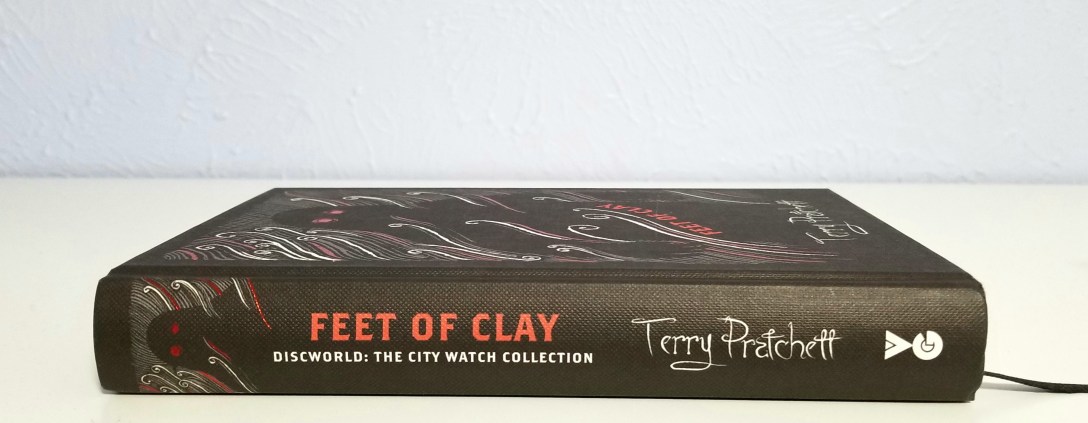
  • Feet of Clay – I can’t pick a top favorite. I just can’t. But Feet of Clay might be it, gun to my head. I won’t give away the book because I think you should read it, but this book speaks to so many levels of human life and emotion; oppression, self-expression, creation, agony, love, duty…and yes, it’s laugh-out-loud funny. But I also cry every time I read it. That’s the power of a really good book, and it’s why I keep coming back to it. I’ve read this book through three times. I got my favorite quote from it on a bracelet.
  • The Hogfather – Another contender for all-time favorite, this book is one I read every Christmas. Yes, there’s a TV miniseries, but its, uh…well, let’s avoid it like we avoid live-action anime moves, yeah? The Hogfather is my favorite book about Death. Not death, the thing, but Death, the character. Death is sad and poignant and funny and earnest and dutiful and not a very good grandfather. His heart would be in the right place if he had one. This is the book from whence comes the greatest quotation on faith I’ve ever heard (see below).
  • Unseen Academicals – Honestly, I skip some parts of this book, and yet, it’s still on my top favorites list. Why? Well, the parts I skip are about soccer. Let’s leave it at that. But the reason it’s one of my favorites is because of two characters; Nutt and Glenda Sugarbean. They are the bravest and best. One of them is definitely not average and one of them definitely is. This book is also one that pulls at my heartstrings while simultaneously making me groan at the amazing punnery. It deals with racism, repression, learning that you can be what you want, not what you’ve been dealt in life, and so, so much more. Honesty. Integrity. Beauty. And soccer. Um. The bucket of crabs scene still gets me every time.
  • The Wee Free Men – This is the first book of the Tiffany Aching series. I love it because Tiffany is a child, with childish selfishness and childish dreams and yet, she has the capacity and the tenacity to save her world. As she grows through the series, we see more of her character develop. Tiffany is not a soft character. She’s tough, she’s often mean, but she always does what’s right. She’s also accompanied by tiny blue Scotsmen, and you just can’t go wrong with that.

Where to Start Reading

Those are just my top four books. I wanted to include about twenty others, but that’s half the series, and I decided to stop while I was ahead.

When I first started reading, it took me a while to get into it. The first couple of books are pretty much your basic fantasy. I didn’t much like Rincewind, and was more reading it to understand where other references had come from, so I had to push through the first few books until I got to Guards! Guards!. That’s where I got really and truly hooked.

So if you’re looking to start reading, you have a few options.

You can start at the beginning and go chronologically. It does make a difference, because the books build on each other and what’s happened in the world. I wouldn’t say it’s a must, though. You could start in the middle and fall in love and go back to read the others as sorts of prequels.

Depending on your kind of book, you might start with a series. The City Watch series centers around the fantastic city of Ankh-Morpork and a member of the Watch, Sam Vimes, as he struggles to remain average in a city full of weirdos.

The Death Series obviously centers on the anthropomorphic personification Death and his adventures. Also amazing. Also touching and tearful in parts.

Then we have the Witch series (and I would put the Tiffany Aching series in there as well), which is more fantasy feeling, and the Industrial Revolution series, for anyone who loves that kind of time period, and the few standalone stories. In my opinion, you could start either at the beginning with the Wizards or at the beginning of one of the character series or go chronologically.

Really, there’s no wrong way to read the Discworld.

My Favorite Quotes

“All right,” said Susan. “I’m not stupid. You’re saying humans need…fantasies to make life bearable.”

REALLY? AS IF IT WAS SOME KIND OF PINK PILL? NO. HUMANS NEED FANTASY TO BE HUMAN. TO BE THE PLACE WHERE THE FALLING ANGEL MEETS THE RISING APE.

“Tooth fairies? Hogfathers? Little—”

YES. AS PRACTICE. YOU HAVE TO START OUT LEARNING TO BELIEVE THE LITTLE LIES.

“So we can believe the big ones?”

YES. JUSTICE. MERCY. DUTY. THAT SORT OF THING.

“They’re not the same at all!”

YOU THINK SO? THEN TAKE THE UNIVERSE AND GRIND IT DOWN TO THE FINEST POWDER AND SIEVE IT THROUGH THE FINEST SIEVE AND THEN SHOW ME ONE ATOM OF JUSTICE, ONE MOLECULE OF MERCY. AND YET—Death waved a hand. AND YET YOU ACT AS IF THERE IS SOME IDEAL ORDER IN THE WORLD, AS IF THERE IS SOME…SOME RIGHTNESS IN THE UNIVERSE BY WHICH IT MAY BE JUDGED.

“Yes, but people have got to believe that, or what’s the point—”

MY POINT EXACTLY.  

– Susan and Death, The Hogfather


Fear is a strange soil. Mainly it grows obedience like corn, which grows in rows and makes weeding easy. But sometimes it grows the potatoes of defiance, which flourish underground.

– Small Gods


There are, it has been said, two types of people in the world. There are those who, when presented with a glass that is exactly half full, say: this glass is half full. And then there are those who say: this glass is half empty.The world belongs, however, to those who can look at the glass and say: ‘What’s up with this glass? Excuse me? Excuse me? This is my glass? I don’t think so. My glass was full! And it was a bigger glass! And at the other end of the bar the world is full of the other type of person, who has a broken glass, or a glass that has been carefully knocked over (usually by one of the people calling for a larger glass), or who had no glass at all, because they were at the back of the crowd and had failed to catch the barman’s eye.

– The Truth


“The secret is not to dream,” she whispered. “The secret is to wake up. Waking up is harder. I have woken up and I am real. I know where I come from and I know where I’m going. You cannot fool me anymore. Or touch me. Or anything that is mine.”

– Tiffany Aching, The Wee Free Men


I believe in freedom, Mr. Lipwig. Not many people do, although they will, of course, protest otherwise. And no practical definition of freedom would be complete without the freedom to take the consequences. Indeed, it is the freedom upon which all the others are based.

– Vetinari, Going Postal


Why do you go away? So that you can come back. So that you can see the place you came from with new eyes and extra colors. And the people there see you differently, too. Coming back to where you started is not the same as never leaving. 

― A Hat Full of Sky


And Tiffany knew that if a witch started thinking of anyone as “just” anything, that would be the first step on a well-worn path that could lead to, oh, to poisoned apples, spinning wheels, and a too-small stove… and to pain, and terror, and horror and the darkness.

― The Shepherd’s Crown


Esme Weatherwax hadn’t done nice. She’d done what was needed.

― The Shepherd’s Crown


HUMAN BEINGS MAKE LIFE SO INTERESTING. DO YOU KNOW, THAT IN A UNIVERSE SO FULL OF WONDERS, THEY HAVE MANAGED TO INVENT BOREDOM.

― Death, The Hogfather


“Now if I’d seen him, really there, really alive, it’d be in me like a fever. If I thought there was some god who really did care two hoots about people, who watched ’em like a father and cared for ’em like a mother . . . well, you wouldn’t catch me saying things like ‘there are two sides to every question’ and ‘we must respect other people’s beliefs.’ You wouldn’t find me being gen’rally nice in the hope that it’d all turn out right in the end, not if that flame was burning in me like an unforgivin’ sword. And I did say burnin’, Mister Oats, ‘cos that’s what it’d be. You say that you people don’t burn folk and sacrifice people anymore, but that’s what true faith would mean, y’see. Sacrificin’ your own life, one day at a time, to the flame, declarin’ the truth of it, workin’ for it, breathin’ the soul of it . . . That’s religion. Anything else is . . . is just bein’ nice. And just a way of keepin’ in touch with the neighbors. Anyway, that’s what I’d be, if I really believed. And I don’t think that’s fashionable right now, ‘cos it seems that if you sees evil you have to wring you rhands and say ‘oh deary me, we must debate this.’ That my two penn’orth, Mister Oats.”

― Granny Weatherwax, Carpe Jugulum

There you have it. A review/open love letter to my favorite series. I keep trying to get people to read it. I haven’t met many who have, and I think most people hear 41 novels and turn a bit green thinking they have to read ALL of them or none.

But if you have read it, how has it impacted you?
Signature

Today I Married Myself

I know what you’re thinking. This title is click-bait, up there among the lady who married a bridge and the man who married a box of pizza.

It’s not like that, I swear.

I’ve been reading the book I mentioned in this post, Emotional Agility by Susan David, and it’s…well, it’s one of those books I think should be mandatory reading if you are human.

In the first section, she talks about self-compassion, about accepting yourself for better or for worse. Sounds like marriage vows to me.

I gave it a try. Self, I accept you, body and soul, till death do us part.  Yeah, it was just as stupid and crazy to do as it sounds. I didn’t put on a dress, thank heavens, or play music, although the music might have helped. I just spoke the words to myself, thinking of all the times I’d treated myself like absolute shit, speaking ill right in front of me, blaming me for every failure and setback, and ultimately deciding I was just no good, willing to leave me for another, younger, better version of myself.

Except, unlike marriage, I can’t actually divorce myself. I can only learn to live with me, which, when you take into consideration my annoying eating habits and tendency to leave clothes on the floor, is no mean feat.

I’m trying to make it comical, but it was really quite a turnaround in thinking. Just like in marriage, and in any other relationship, you work at it. You work at being kinder and fighting better and caring for the other even when they’re being a lazy bum and not doing what they promised they would.

Marriage means accepting the other for better or worse, in sickness and health, in productive times and unproductive times, in financial straits or excess. It means you’re committed to being in it for good.

So the same with this notion I had, of, well, not marrying myself, but treating myself better.

Self-compassion, self-care, treat yo’ self – these are all popular buzzwords in society today. But they often take a dangerous form known as enabling. Enabling is typically when a partner, friend or parent allows their loved one to engage in damaging behavior (drugs, alcohol, bad health habits, bad financial habits, seeing bad friends, verbal abuse, etc) and doesn’t call them out on it. The justification is usually that they don’t want to hurt their loved one and don’t want to force them to face the consequences of their actions. Parents continue to give money to grown children who won’t face responsibility. Wives don’t follow through on threats to leave their alcoholic husband. Friends don’t tell each other the person they’re dating is treating them poorly.

This so-called love and compassion is more damaging than helpful, and we often take this stance with ourselves too. We’re so harsh on ourselves normally that we cave in the name of treating ourselves and go to the opposite extreme of trying to let overindulgence, impulsive shopping, or working on something other than our dreams make us feel better about ourselves. In the same way that enabling allows destructive behavior to continue, treating ourselves to cheap and fast rewards leads to less happiness overall.

Instead, as in a good marriage, we need to call ourselves out on bad behavior with compassion and love. We don’t need to rail about how awful we are for failing to work on that project again, or overeating again, or yelling at our kids again. We need to ask why we’re reacting that way, what the deeper issue is, and work to resolve it. We need to have more constructive self-care habits, like meditation, connection with supportive and healthy friends and finding something we value to invest time in.

That’s a good marriage. That’s a good relationship. That’s what I’m trying to do for myself. I’m a pretty nice person. A lot of people have said so. But I’m not nice to myself most of the time. I judge myself by a far higher standard. Most of us do that. We know what we want and what our version of perfect is, and we rarely meet that standard.

The answer is not mindless indulgence after a bout of self-loathing. The answer is healthy communication and honesty with ourselves.

Marry yourself. I recommend it.*

Signature

*THIS IS A JOKE. I took it too far, yes. You get the picture.